Alex Davis, the mastermind behind the fantastic Edge/Sledge Lit conventions at Derby Quad (which I've written about extensively, as you can see here) has now posted the modules in his latest online writing school.
I am thrilled to be involved with such a great line-up of writers and very happy to be putting on a module for "Plotting and Planning" alongside my dear old chum and plotting partner David Roberts.
While we haven't finalised our event yet, we'll be going through the processes that have so far seen the creation of four thriller novels with the fifth just about to get underway. This will cover everything from the initial idea to creating a spine for the set pieces and how to put together compelling characters. There might also be a practical element where we plot out a novella in the session!
More details on the event link here and David & I hope to see some of you online.
I can guarantee it'll be fun and you never know, we might even teach you a new trick! Get your tickets and find out!
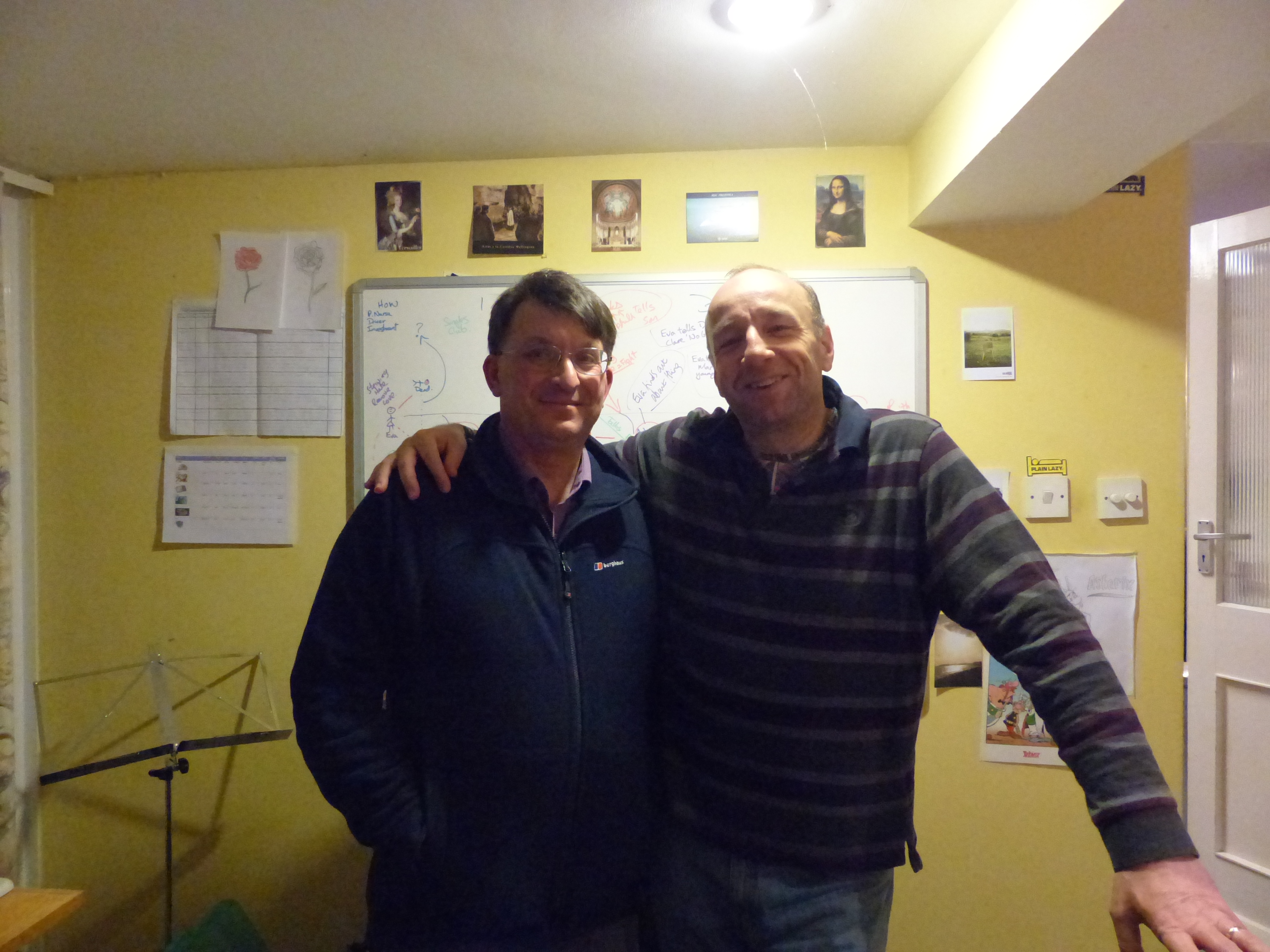
David & I in his study standing in front of the white board where we'd just finished bashing out the plan for what became ONLY WATCHING YOU.
My fine friend Richard Farren Barber has a new novella out from Crystal Lake Publishing called Twenty Years Dead (it's very good) and to help celebrate it, he's contributed the following guest post.
After twenty years in the ground, the dead briefly rise. At his father’s grave, this is Dave’s last opportunity to discover why a man would abandon his wife and young son. Against the protests of his mother and his girlfriend, Dave is determined to learn what happened all those years ago. Sometimes you have to risk everything, but the dead don’t give up their secrets so easily.
Twenty Years Dead is a novella of quiet horror, which explores families and their secrets.
Come listen when the Dead speak...
* * *
You'd have thought after thirty plus years (gulp) I'd have a handle on this writing malarkey. Write. Edit. Publish.
Simples.
And sometimes that's exactly how it works. My most recently published novella is Twenty Years Dead and that was a straightforward delivery. The first draft was written in 4 weeks and then it took a few more weeks for editing before it was ready to go out.
Not so much the current novella. It's not hideously complex but I've already had to pull it apart and restructure it, shifting around scenes, deleting chapters and adding new material. And still it’s very, very wrong.
It’s not necessarily the chronology of the story which creates complications – in both cases the story follows a conventional storyline, but sometimes it’s clear from reading the first draft that something has gone awry. For me it’s often about character motivation, or development. It’s often the case that something just doesn’t feel right.
There's a part of me which loves the dissection: it’s very satisfying taking something apart, figuring out how it actually works and how it should work. But here's the thing; once you start messing with the order of your first draft it quickly unravels. It reminds me of times as a child when I took apart a toy only to discover I couldn't put it back together again. After a few hours of focussed play you find yourself with a handful of plastic pieces and a knot of wires and rubber bands.
(Quick aside for those brought up in the seventies: The Casdon tabletop football game used a *lot* of strings to make those players move. Who knew?)
You put your story together in what you think is the right order and suddenly characters gain knowledge they can't possess, or reference events which have not happened. It's amazing how complicated simple things can become.
When I'm sitting there staring at my disembowelled story there is a temptation to shove all the guts back in and just hope no-one notices. Even when the major structural work is done and all the scenes are in the right order the details continue to trip me up. It can be something as miniscule as realising you’ve referenced a building which no longer exists, or by introducing characters in a different order they need to change their view on events.
I often find myself wondering whether any reader would spot the inconsistencies or whether I'm self-flagellating. I suspect someone would, but in truth I don't know. But I’d know, and I think that’s the only thing I can offer as a writer: integrity.
Every time I am editing a story I wish I planned my tales better and I promise myself next time I'll write a proper outline. Outlining seems like the Holy Grail as a writer. When I begin writing a new story I usually have a very clear vision of the beginning and an understanding of the end but the middle tends to be hazy. Some of the characters in Twenty Years Dead were known to me from the outset while others bloomed into existence as the pages racked up. For me, that discovery during the first draft is one of the real joys of writing; I just need to find a way to do it before I start page one.
Me & Richard in Nottingham during a Crusty Exterior meet-up in April 2019 I wrote about here
Richard Farren Barber was born in Nottingham in July 1970. After studying in London he returned to the East Midlands. He lives with his wife and son and works as a manager for a local university.
He has over 80 short stories published, seven novellas: “The Power of Nothing”, “The Sleeping Dead”, “Odette”, “Perfect Darkness, Perfect Silence”, “Closer Still”, “All Hell.” , and “Twenty Years Dead.” His two novels are: “The Living and the Lost” and “The Screaming Dead” (Co-authored with Peter Mark May).
Richard can be found online at the following links:
Frenzy, Sir Alfred Hitchcock’s 52nd film as director, opened in the UK on 25th May 1972. It was produced by William Hill, written by Anthony Shaffer (from the novel by Arthur La Bern) and the director of photography was Gil Taylor. Syd Cain was the production designer, Albert Whitlock supervised the visual effects and John Jympson was the editor.
After the brutal murder of his ex-wife, down-on-his luck former RAF pilot Richard Blaney is suspected of being the ‘Neck Tie Murderer’, a vicious serial killer terrorising London. With the help of his friends, Blaney goes on the run, determined to prove his innocence.
In 1970, looking for a new project after Topaz (1969), Sir Alfred Hitchcock was given a copy of Goodbye Piccadilly, Farewell Leicester Square by Arthur La Bern and he later told journalist Rebecca Morehouse “I was attracted by the market [scenes] and by the central figure, an Air Force man who is always a loser. Today is the day of the non-hero, isn't it?” Excited by the novel and its location, he pitched it to Lew Wasserman and Edd Henry at Universal over a lunchtime meeting and they agreed to make it, on a $2.8m budget.
Hitchcock decided it would be best to make the film in London with an all-British cast and rang playwright Anthony Shaffer, whose Sleuth was then a hit on Broadway, to ask him to adapt the novel. After Shaffer (who originally thought the call was from friends playing a joke) agreed, the two men met in New York in January 1971 to discuss the adaption, before going to London to scout locations, looking over Hyde Park, Leicester Square, Piccadilly, Oxford Street, Bayswater, Hammersmith and Covent Garden Market.
The script meetings continued throughout February and several parts of the novel were cut back, such as the court scenes, or excised altogether, such as Blaney's escape to France. In addition, Hitchcock insisted on using phrases from his childhood (spent in London), as Shaffer explained to Donald Spoto, “[he] was intractable about not modernising the dialogue of the picture, and he kept inserting antique phrases I knew would cause the British public a hearty laugh or even some annoyance.”
The downbeat ending of the book was changed to a more satisfying conclusion and Hitchcock and Shaffer added a recurring theme of food, along with biblical references to the Garden of Eden and Original Sin. The part of Chief Inspector Oxford was also enhanced and light relief added during mealtime scenes with his haute cuisine interested wife who was busy carrying out culinary experiments. Although Shaffer wrote the screenplay on his own, which was completed well before filming began, Hitchcock had a firm idea of where he wanted the story to go and co-wrote the 55-page treatment the 160-page script was based on.
Mrs Oxford (Vivien Merchant) serves up another delight for Chief Inspector Oxford (Alec McCowen)
Casting for actors and crew began in May and Hitchcock renewed some old professional acquaintances. Cinematographer Gil Taylor had been clapper-boy on Number Seventeen (1932), sound mixer Peter Handford worked on Under Capricorn (1949) and Elsie Randolph (who plays Gladys the hotel clerk) had appeared in East Of Shanghai (1931).
Hitchcock cast seasoned British actors for the other roles, recognised in the UK but relatively unknown in Hollywood at the time. Alec McCowen (Chief Inspector Oxford), Barry Foster (Bob Rusk), Billie Whitelaw (Hetty Porter), Anna Massey (Barbara Milligan), Vivien Merchant (Mrs Oxford) and Barbara Leigh-Hunt (as Brenda Blaney) from the stage were joined by TV stars Bernard Cribbens (Felix Forsythe), Michael Bates (Sergeant Spearman), Clive Swift (Johnny Porter) and Jean Marsh (Monica Barling). As he had with Psycho (1960), where Norman Bates is much older than Anthony Perkins, Hitchcock cast the much younger Jon Finch as the anti-hero Richard Blaney (who, named Blarney, is nearly fifty in the novel) though when he later openly criticised the script to journalists, Hitchcock was close to recasting - he'd wanted Michael Caine for the Rusk role but the actor turned it down (“I don’t want to be associated with the part”). Hitchcock had seen both Foster and Billie Whitelaw in Twisted Nerve (1968).
Bob Rusk (Barry Foster, on the right) helps out his old friend Richard Blaney (Jon Finch)
With regard to the look, Hitchcock told Gil Taylor he wanted “a realistic nightmare, rather than a ‘Hammer Horror’” with Covent Garden as the backdrop, referring back to a selection of Vermeer paintings. The son of a Covent Garden merchant, Hitchcock was keen to film at the market and, perhaps aware its working days were numbered (it remains a thriving tourist part of London today), to document it too.
Hitchcock’s wife, Alma, had flown to London intending to spend a few weeks in England before embarking on a European tour with their daughter Patricia and granddaughter Mary. After a weekend break to Scotland, Alma suffered a serious stroke and was treated at Claridge’s Hotel by Hitchcock’s personal physician. She recovered enough to watch dailies with her husband and Barry Foster said later that Hitchcock awaited her reaction “like a schoolboy, showing his homework to the teacher.” Alma flew home to Los Angeles in October to receive further treatment.
Hitchcock on the Thames
Filming began in the last week of July 1971 with assistant director Colin Brewer heading the second unit, as well as handling many of the first unit set-ups for Hitchcock, who was suffering badly with arthritis.
Hitchcock in Covent Garden with Gil Taylor (centre) and Colin Brewer
Filming progressed smoothly and though a lot of the exteriors were filmed around Covent Garden, plenty of other London locations were utilised including Tower Bridge and County Hall (for the opening sequence), the Coburg Hotel on Bayswater Road, Hyde Park and the London Hilton on Park Lane. Brenda Blaney’s flat is in Ennismore Gardens Mews and her matrimonial agency is at Dryden Chambers (since demolished), just off Oxford Street. Filming also took place at New Scotland Yard, Wormwood Scrubs and St Mary Abbot’s hospital and the production was granted permission to film inside the Old Bailey the first full weekend in August. The interiors were filmed at Pinewood Studios, with sets often on stand-by to serve as ‘weather cover’.
Hitchcock with Anna Massey
Hitchcock puts in his traditional cameo appearance during the opening scene at County Hall, where he’s in the middle of the crowd wearing a bowler hat. Teaser trailers showed his dummy floating in the River Thames.
The final three weeks of filming were taken up with the complex sequence on the potato truck and principal photography ended after thirteen weeks on 14th October, though the second-unit worked for another week.
The celebrated tracking shot out of Rusk's flat, which is as stunning now as it was then, was filmed using a camera dolly since the steadicam wouldn’t be invented for a couple of years. The interior was filmed at Pinewood Studios, the exterior (the edit masked by a passing porter) at 3 Henrietta Street, Covent Garden.
During the shoot, Hitchcock was reportedly happiest when filming around Covent Garden, a place he hadn’t visited in decades but where he’d spent time with his father. Anna Massey later said, “It’s a brutal film, but full of things Hitchcock loved - like food, and London - and it’s a very loving portrayal of Covent Garden market.”
In interview, Anthony Shaffer said, “An old chap made his way up to Hitchcock at the market...and said, ‘I remember your father here, in all this mud.’ Hitchcock was delighted, took the man for an expensive lunch and had a long talk to him about his dad.”
Hitchcock, at Pinewood Studios, works with Barry Foster (left) and Alex McCowen
The film also included this incredible Albert Whitlock matte painting of Covent Garden - the only 'live' section is the space between the green door and the truck.
Hitchcock returned to Los Angeles on 26th October and he and John Jympson created the rough cut of the film during November. The editor then flew back to London to supervise post-synching of the dialogue and Henry Mancini began work on the score.
Best known for Breakfast At Tiffany’s (1961) and the Pink Panther series, Mancini had also scored The Creature From The Black Lagoon (1954) and Touch of Evil (1958). He told Catherine Scott of The Guardian, “‘Frenzy’ is very low-key picture about a neck-tie murderer, and what I have done is to just cut off the orchestra round middle C. There is none of the screeching, high, intense sounds that would be thought a little melodramatic today. It is very sparse... there's not a lot going on, but what there is will, I trust, sound pretty spooky.”
Hitchcock attended the London recording sessions in mid-December and then rejected the completed score outright. Mancini later said, “he decided that it didn’t work, [he felt] the score was macabre, which puzzled me because it was a film with many macabre things it in. It wasn't an easy decision to accept, and it was crushing when it happened...” Unlike his acrimonious split with Bernard Hermann over the rejected score for Torn Curtain (1966), relations remained amicable and Mancini mentions in his autobiography that Hitchcock sent him a case of Château Haut-Brion magnums.
Hitchcock then hired British composer Ron Goodwin, providing him with thorough instructions and notes regarding the new score. The recording sessions for this took a week, beginning Monday 31st January 1972. By mid-February, Jympson had edited in Goodwin’s score and the film was sent back to Los Angeles where small adjustments were made before the end of the month.
Due to the content - it’s the first Hitchcock film to show nudity and the sex killing was very strong for the time (it still is, to be honest) - this was the first of the director’s films to receive an ‘R’ rating in the US and an ‘X’ in the UK.
Hitchcock in Cannes
Frenzy was shown, out of competition, at the Cannes Film Festival in May 1972 where it was hailed as a “late-career masterpiece”. He’d been worried - as hard as it is to believe now, there were people at the time who believed Hitchcock was becoming irrelevant - but the critical praise buoyed him. At a screening in Paris, Francois Truffaut (a great fan and terrific director in his own right) said the Hitchcock touch was much in evidence and that the old master was “still experimenting”.
Alma, with the dummy Hitchcock head
The trailer also features Hitchcock, in amusing mood. “This,” he says, “is the scene of a horrible murder - it’s the famous wholesale fruit and vegetable market, Covent Garden. Here, you may buy the fruits of evil and the horrors of vegetables.” At that point, a foot sticks up out of a potato sack.
The London premiere was held on 25th May 1972 and critical reception was generally very good though several complained it was distasteful. One of these was Arthur La Bern who wrote, in a letter to the editor of The Times, “Sir, I wish I could share John Russell Taylor's enthusiasm for Hitchcock's distasteful film. The result on the screen is appalling.” The issue of the films graphic nature was discussed widely and both the US and UK censors had required minor cuts to the murder sequence (though Hitchcock and Shaffer had toned down the violence from the novel).
By this time, Alma had recovered sufficiently well that she was able to accompany Hitchcock on the publicity tour which lasted well into the year.
Frenzy received four Golden Globe Award nominations - Best Motion Picture - Drama, Best Director, Best Screenplay and Best Original Score - but didn’t win any. It ended 1972 listed at number 33 in Variety’s “Top 50 Grossing Films of the Year” list, with a box-office take of $4.8m. On a budget of $2.8m, to date it has earned over $21m.
Happy anniversary, Frenzy. As Bob Rusk might say, “lovely...”
Kiss The Dirt (Falling Down The Mountain) was written by Andrew Farriss & Michael Hutchence and released in Australia on 3rd March 1986 - in the UK we had to wait until 30th August. It was backed with Six Knots, written, performed and produced by Kirk Pengilly (it lasted 51 seconds) and The One Thing (Live), written by Farriss & Hutchence and mixed by Mark Opitz.
The third of four singles from the album (following This Time, released in 1985 in the US and Europe and What You Need in August 1985 - the first Australia/New Zealand release - and followed by Listen Like Thieves, released in the UK in 1985 but 1986 in Australia), it peaked at number 15 in Australia, 42 in New Zealand and 54 in the UK.
Falling down the mountain
End up kissing dirt
Look a little closer
Sometimes it wouldn't hurt
The video was filmed in South Australia in two locations. The white salt lake was at Lake Heart, while the red desert scenes were filmed at Moon Plains, which was also the location for Mad Max 3. It was directed by Alex Proyas who started his career making pop videos before moving to Hollywood and making, amongst others, The Crow (1994), Dark City (1988) and I, Robot (2004). Listen Like Thieves was released on 14th October 1985 and is widely considered to be the international breakthrough album for the band. It was produced by Chris Thomas, who had previously worked with The Beatles, Pink Floyd, The Sex Pistols (on Never Mind The Bollocks) and Elton John and of whom Richard Clapton said, “INXS met their match - he was the only producer they've ever had who told them what they needed to hear.” Michael Hutchence later said, “This is what we've been trying to do one way or another for a few years now, that is to make an album that is purely just form and function of the songs. It has no artistic pretensions.” The album was recorded at Rhinoceros Studios in Sydney from June to August 1985, after initial sessions in March, finishing in August 1985 and including a break for a South American tour. The album spent two weeks at number 1 on the Australian Kent Music Report Albums Chart, peaked at number 11 on the US Billboard 200, 24 on the Canadian RPM 100 Albums and 46 on the UK charts. I wrote about the album here, on its 30th anniversary.
The four singles released from the album all had accompanying videos.
This Time was directed by Peter Sinclair and produced by Godley & Crème
Kiss the Dirt (Falling Down the Mountain) was directed by Alex Proyas and produced by Andrew McPhail.
What You Need and Listen Like Thieves were directed and produced by Richard Lowenstein, continuing the successful collaboration that had started on the previous album, The Swing, with his videos for Burn for You (which won the 1985 Countdown Music and Video Awards for Best Promotional Video), Dancing on the Jetty and All The Voices. Lowenstein would go on to establish a long term relationship with the band until Hutchence’s death.
Regular readers will know I'm always fascinated by the behind-the-scenes process of films, especially special effects work with miniatures (which I've blogged about here), matte paintings (which I've blogged about here) and making-of books. I also love Raiders Of The Lost Ark (and wrote a retrospective piece on it, which you can read here) which, unbelievably, turns 40 this week (released on 31st July 1981 here in the UK). So while this isn't the most up-to-date review I've ever posted, it was the perfect book for me this week.
Already a fan of George Lucas and Steven Spielberg then, I went to see it that summer with my best friend Nick and loved it. We both did, though it took him a long time to stop making fun of me because I got scared when the pretty ghost turned into a monster after the Ark had been opened.
To help celebrate the anniversary, I’ve been on a bit of a Raiders jag and one element was this making of. First published in paperback in 1981, it includes a batch (32 pages) of “spectacular behind-the-scenes photos” (all black and white) and is a real old school making-of, the kind that’s almost as much a memoir as anything else. It’s also the kind that doesn’t get published these days.
Richard Amsel's iconic poster, which adorned my bedroom wall for a long time.
Derek Taylor writes well and he really is our guide, explaining the situation (in laymans terms), the script as he sees it, the troubles with the locations and the pace of the production. As if you were sitting together as he caught you up on news, he relates chatting with various actors and crew members and they all come across as being really lovely - Harrison Ford remembers him from the Monterey pop festival, he goes for a walk with Karen Allen and Ronald Lacey befriends holidaymakers at the Tunisian hotel where the main crew and cast (but not the writer) are staying.
Karen Allen, George Lucas, Steven Spielberg and Harrison Ford on location in Tunisia
Taylor interviewed a lot of people and most of the twenty-three chapters (there’s also a prologue and epilogue) contain at least one with Spielberg and Lucas themselves, as unguarded in interview as I think I’ve ever read. Chapters are devoted to interviewing (in order) Howard Kazanjian (the co-executive producer), Frank Marshall (producer), Norman Reynolds (production designer, who Spielberg is particularly enamored of due to his work on Star Wars) and Tom Smith (the make-up designer). The stand-ins get their say and interviews continue with Robert Watts (producer), Harrison Ford, David Tomblin (assistant director, who’s a big presence in the behind-the-scenes documentaries for both this and Return Of The Jedi), Terry Leonard (stunt man), Martin Grace and Wendy Leach (the stunt doubles in England - Leach would go on to marry Vic Armstrong, who also did some of the stunts for Indy here and took over completely for the next two films), Karen Allen, Roy Charman (sound man), Kit West (special effects) and Douglas Slocombe (the director of photography). Taylor also visited ILM (and clearly didn’t really understand any of the processes Richard Edlund talks about) and attended some of the scoring with John Williams.
The amount of detail that comes across is impressive, some of it amusing forty years down the line. Kit West, for example, talks about creating black smoke cheaply by buying tyres “for pennies” and setting fire to them, rather than using more expensive (but more environmentally friendly) smoke pots - different times indeed.
Filming on Norman Reynolds' island set at Elstree Studios
Hugely comprehensive and yet still chatty, this is a terrific read, faithfully following a huge crew with one aim who seemed to get on very well together and, as we know, produced a fantastic film. If you’re used to the modern coffee-table style of making of book (which I also love, except those that feature page after page of technicians sitting in front of computer monitors), this might not be to your taste, but for a proper old-school approach, celebrating a proper, old-school action movie where pretty much everything you see actually happened, I don’t think you could do much better. Highly recommended - the book and film (and, if you can get hold of it - as I did, to satisfy my Raiders thirst - I’d also recommend the 180g vinyl re-issue soundtrack double album).
Lunch in Tunisia, with executive producer Howard Kazanjian on the far left
Derek Taylor (7th May 1932 - 8th September 1997) was an English journalist, writer, publicist and record producer. The Beatles press officer (he was sometimes called ‘the Fifth Beatle’), he also worked as a publicist for the Byrds, the Beach Boys, the Mamas and Papas, helped organise the 1967 Monterey Pop Festival and headed up publicity for Apple Corps from 1968. After working for Warner Brothers during the 1970s he then moved to Handmade Films with his close friend George Harrison (while editing Harrison’s 1980 autobiography I, Me, Mine) and wrote several books, including the Raiders making of. Returning to Apple Corps in the 90s, he was working on the Beatles anthology book at the time of his death.
This iconic shot features in the narrative, a lucky accident that Spielberg saw the sunset and decided to incorporate it
Taylor is surprised at the size of the Tunisian dig set - and at how the extras are treated. After he informs Spielberg (who wasn't aware), changes are quickly made.
The final sequence, with the "complicated" ILM work included
For Your Eyes Only, the twelfth James Bond film in the official EON series (and the fifth to feature Roger Moore in the lead role), opened in the UK on 26th June 1981. It was directed by John Glen (the first in his eventual five-film run), produced by Albert R. “Cubby” Broccoli and written by Richard Maibaum & Michael G. Wilson. Peter Lamont was the production designer, Derek Meddings supervised the visual effects and Bill Conti wrote the score. The film was originally planned for release in 1979 to follow The Spy Who Loved Me (it’s announced at the end of that film) but was put back to allow Moonraker to go into production.
UK quad poster
Following the outer space excess of Moonraker (which remained the series highest grossing entry until Goldeneye in 1995), producer Cubby Broccoli wanted a conscious return to the style of the earlier Bond films and, indeed, the novels of Ian Fleming. For Your Eyes Only, he decided, would be stripped back of gadgets and humour, allowing for a grittier, more realistic approach - a reboot before they were in fashion, as it were. Broccoli’s stepson, Michael G. Wilson, had been made an executive producer for Moonraker and was given more creative input in the series. He agreed with the need to get back to basics and collaborated on the screenplay with Bond veteran Richard Maibaum. The script took key elements from two of Fleming’s short stories - Risico (Kristatos and Columbo) and For Your Eyes Only (the murder of the Havelocks) - and included unused sequences from Live And Let Die (the keelhauling), Goldfinger (the Indentigraph, called the Identicast in the novel) and On Her Majesty’s Secret Service (the winter sports). The macguffin of the film - the ATAC - and the villain Locque were both added by the pair.
As the script was being written, Broccoli had a major problem in that Roger Moore was undecided as to whether or not he wanted to continue. His original three-film contract took him up to The Spy Who Loved Me and following that, he negotiated contracts on a film-by-film basis. This uncertainty led to other actors being considered for the role, including Lewis Collins (then well-known as Bodie in The Professionals), Michael Billington (who played Anya’s lover in The Spy Who Loved Me) and Michael Jayston. Broccoli worked hard to persuade his friend and star to make at least one more film and Moore, helped by a substantial increase in his salary, eventually signed on, though he remained uneasy about the tougher character he was being asked to play. For my part, I think this is probably his best performance as Bond - he still has some quips but they’re toned down from the 70s excesses and his character shows a harder, more vengeful streak. His age also seems to be acknowledged, especially with the young ice skater Bibi - he rebuffs her advances by saying “You get your clothes on and I’ll buy you an ice cream.”
At work in Cortina - front left - Tony Waye (Assistant director), Bob Simmons (Action co-ordinator), Roger Moore, Cubby Broccoli, John Glen, Michael G Wilson
Further to the back-to-basics philosophy, there were several changes in the key crew. John Glen, who’d worked as editor and second unit director on a number of previous Bond films, was promoted to director. Ken Adam, the production designer, was working on Pennies From Heaven in America and when his assistant Peter Lamont was asked who he thought should replace him said “why not me?” Both Glen and Lamont decided to pull back from Adam’s trademark grand sets in favour of a more realistic design.
Of the old guard, both Desmond Llewelyn (Q) and Lois Maxwell (Miss Moneypenny) returned but Bernard Lee, who’d played M since Dr No (1962) was hospitalised with stomach cancer and died on 16th January 1981 before he could film his scenes. As a mark of respect, the part wasn’t recast and his dialogue was split between Q, the Minister Of Defence (Geoffrey Keen) and Bill Tanner (James Villiers).
from left - Carole Bouquet, Lynn-Holly Johnson, Cassandra Harris
Carole Bouquet, who had previously auditioned for the part of Holly Goodhead in Moonraker, was chosen to play the vengeful Melina Havelock and in an interesting twist became the first Bond girl who doesn’t share a love scene with our hero until the closing credits. She is also only a year older than Lynn-Holly Johnson. Julian Glover, who’d once been shortlisted as a potential Bond prior to Live And Let Die was cast as Kristatos, whilst Chaim Topol was suggested by Broccoli’s wife Dana for Bond’s ally Columbo (and it was he who came up with the pistachios quirk). Cassandra Harris, cast as Countess Lisl, took her fiance to lunch with Broccoli and his team, the first time any of them were to meet Pierce Brosnan. Lynn-Holly Johnson, who played Bibi Dahl, was a professional ice skater Broccoli had seen and liked in the film Ice Castles (1978). Michael Gothard played Kristatos’ henchman, the hired assasin Emile Locque, who doesn’t say a single word throughout the film (though he screams as he dies). Unfortunately, the film ends with a cringeworthy sequence featuring then Prime Minister Margaret Thatcher (played for laughs by Janet Brown) which doesn’t sit with the tone of the film at all, dates it badly and feels like a terrible joke that should have been cut in the scripting stage. Roger Moore reportedly hated it too.
from left - Julian Glover, Topol
Since John Barry was unable to work in the UK at the time, American composer Bill Conti - best known for his work on the Rocky films - was chosen. His score, very much of its time, doesn’t really suit the film (though it’s an decent enough listen) and has dated quite badly (though I maintain that the discordant piano during the ski sequence fits the visuals perfectly). Conti also wrote the music to go with Michael Leeson’s lyrics for the title song, sung by Sheena Easton who maintains the honour of being the only singer to feature in the opening titles. The song reached number 8 in the UK charts, number 4 in the US and was nominated for the Best Song Oscar. Blondie were asked to submit a song but it was rejected - it’s available on their album The Hunter and, I think, would have worked just as well.
On a budget of $28m ($6m less than Moonraker), Bond was ready to head into the 1980s.
“We had gone as far as we could into space. We needed a change of some sort, back to the grass roots of Bond. We wanted to make the new film more of a thriller than a romp, without losing sight of what made Bond famous - its humour.”
- John Glen
Production began on 2nd September 1980 in the North Sea, filming exterior scenes with the St Georges (interiors were shot at Pinewood later, as was the explosion which was filmed in the tank on the 007 stage).
The production moved to Corfu and, on 15th September, began filming at the Villa Sylva at Kanoni, which doubled as Gonzales’ Spanish villa. On a location scout, it had been decided to use the local hills and olive groves for the chase scene between Melina’s Citroën 2CV and the Peugeot 504s driven by Gonzales’ men (Bond’s Lotus was blown up early on to show that he would be relying more on his wits than gadgets). The chase was supervised by Remy Julienne (who would work on every Bond film up to Goldeneye) and filmed over twelve days, using four 2CVs which were modified for the stunts required. The scene includes Roger Moore’s ad-lib “I love a drive in the country, don’t you?” which clearly takes Carole Bouquet by surprise and he has since stated that of all the cars he ever drove as Bond, the 2CV was his favourite.
The Citroen 2CV jumps the Peugeot in the olive groves
The crew moved to Kalambaka on the Greek mainland to shoot in and around the monastery that sits on top of a virtually sheer column of rock. Although permits had been signed and agreed, the monks who lived in the neighbouring monastery of Meteora took exception, complaining that Bond’s reputation for sex and violence was an affront and demanding filming be halted. To prevent filming, they hung laundry out of windows in an attempt to ruin the shots. Local people and the government intervened and shooting was allowed to continue, though only exteriors were used - St Cyrils monastery itself was built at Pinewood. On location, Roger Moore - who has a fear of heights - had to resort to some ‘moderate drinking’ to calm his nerves but the fall was performed by Rick Sylvester (who also did the parachute jump at the start of The Spy Who Loved Me). Derek Meddings developed a system that would dampen the sudden stop and although Sylvester was nervous - he later said “From where we were shooting you could see the local cemetery” - the stunt went without a hitch.
Bond kicks Locque's car off the cliff, the scene that concerned Roger Moore
The raid on Kristatos’ warehouse was also filmed, along with the scene where Bond kicks Locque’s car over the edge of a cliff. Roger Moore felt the scene was too cold-blooded - he said it “was Bond-like, but not Roger Moore Bond-like” (though I would argue his killing of Sandor in The Spy Who Loved Me is just as nasty) - but agreed to film it as originally written. The raid sequence also saw Topol injured, when a piece of debris hit him in the face - the scene is included in the movie, with the actor falling toward Moore.
Could that be Locque, or is it a character from Guess Who?
Returning to Pinewood in Novermber, work began on Peter Lamont’s sets at Pinewood, including the Identigraph scene with Q. On the DVD documentary, Roger Moore (a known practical joker) said he convinced Desmond Llewellyn his dialogue had been changed and handed him new sheets the continuity girl had typed up. Desmond spent his lunch-hour learning the new lines only to discover, when he got on set, that it was a joke. His response is not recorded.
The church in the pre-credits sequence was filmed at Stoke Poges, next door to the golf course from Goldfinger (1964). The sequence of Bond visiting his wife’s grave was written to provide continuity between potentially different actors, when it was still unsure if Moore would be continuing in the role.
Martin Grace hangs on over Beckton Gas Works
The helicopter sequence was filmed at the abandoned Beckton Gas Works in London (later used as a location for Stanley Kubrick’s Full Metal Jacket (1987)). Featuring some excellent stunt work - Martin Grace was hanging onto the Jet Ranger, whilst Marc Wolff was the pilot - it also included an incredible Derek Meddings foreground miniature, which used forced perspective to allow the helicopter to apparently fly into a warehouse. For footage inside the building, a full-scale mock-up was mounted on a rail, allowing Roger Moore to be filmed inside it. The bald man in the wheelchair was clearly meant to be Blofeld but ongoing legal battles with Kevin McClory meant the character couldn’t be named or properly seen. Unofficially disposing of Bond’s greatest villain down a chimney stack was Cubby Brococli’s perfect way of saying the 007 series could survive without Blofeld, who wouldn’t re-appear until Spectre in 2015.
Not-Blofeld at Beckton Gas Works (Martin Grace on the skid)
Whilst the first unit was in England, the second unit, supervised by Al Giddings, shot the underwater scenes in the Bahamas with stand-ins. Since Carole Bouquet had a sinus condition, she couldn’t film underwater so the close-ups of Bond and Melina were shot on a dry soundstage. Smoke, wind, lighting effects and dubbed on bubbles gave the illusion of the actors being submerged. Giddings also co-ordinated the logistically difficult keelhauling sequence with John Glen. The submarine scenes were filmed at Pinewood on the 007 stage tank, where Peter Lamont created two working props for the Neptune, as well as a mock-up with a fake bottom.
Filming the keelhauling sequence in the Bahamas
On 1st January 1981, the production began work at Cortina D’Ampezzo in Italy, where unusually mild weather meant no snow had fallen. Instead, they had to ship some in from nearby mountains and dump it on the city streets. Bond veteran Willy Bogner Jr led the second unit there and designed the chase sequence with Bob Simmons to surpass his work in both On Her Majesty’s Secret Service and The Spy Who Loved Me. As well as being pursued by two motorcycles with studded tyres (to film them, Bogner used skis that allowed him to go forwards or backwards), Bond is also chased on the bobsled track in a gripping and visually dynamic sequence. Unfortunately, on the last day of shooting the run, one of the stuntmen in the sled, 23 year-old Paolo Rigon, was killed after he became trapped under the bob. Although he was an accomplished cross-country skier, Roger Moore wasn’t insured for downhill skiing so Bogner stood in for him. Close-ups were filmed with Moore strapped to a sled being pulled downhill, as Bogner skied backwards operating the camera.
Locque and his men wait for Bond at the ski jump - from left, Claus (Charles Dance), Locque (Michael Gothard), Erich Kriegler (John Wyman)
Robbin Young, who played the florist, won Playboy’s “Be A James Bond Girl” where her prize was a small role and a spread in the magazine. The film also marked the last appearance by Victor Tourjanksy, the ‘Man With Glass’ from The Spy Who Loved Me and Moonraker.
First unit filming wrapped in February. Back at Pinewood, Derek Meddings and his team created miniatures of the St George (and blew it up), Columbo’s yacht for the approach to Kristatos’ warehouse and elements of St Cyrils (including the basket lift).
top - film still bottom - Derek Meddings with the foreground miniature exactly duplicating the real building
A member of Derek Meddings' crew at work on the St Georges miniature, just before the diver explodes (hence the miniatures of Bond and Melina)
For Your Eyes Only premiered at the Odeon, Leicester Square on 24th June 1981 before going on general release on 26th June. The premiere was attended by the Prince of Wales and Lady Diana Spencer, for the benefit of the Royal Association for Disability and Rehabilitation. Topol suggested to Cubby Broccoli that he invite his former Bond co-producer Harry Salzman, which he did, marking the first re-union between the two men since their break up after The Man with the Golden Gun (1974).
left - Concept art for the poster by Brian Bysouth - right - raw photo of Nancy Stafford (the hand and crossbow used in the poster)
The poster, showing a woman standing with her legs spread, was designed by Bill Gold and caused a certain amount of controversy in the US - The Boston Globe and the Los Angeles Times considered it unsuitable and edited out everything above the knee whilst the Pittsburgh Press painted on shorts. I thought it was very good and had a copy of it on my bedroom wall for years. The image is composite from two women Morgan Kane photographed - Joyce Bartle provides the legs (she wore her bikini bottoms the wrong way around) and former Miss Florida Nancy Stafford is the hand holding the crossbow.
Roger Moore presents Cubby Broccoli with his Irving Thalberg Award
Citroen produced a special “007” edition of the 2CV which had decorative bullet holes on the door, Corgi Toys produced die-cast models and a 007 digital watch was also available. Marvel Comics published a comic book adaption (which I read and quite enjoyed), written by Larry Hama and drawn by Howard Chaykin.
At the Oscars on 29th March 1982, Sheena Easton performed the nominated title song and Roger Moore presented Cubby Broccoli with the Irving Thalberg Honorary Award, in honour of the Bond series. The script was nominated for Best Adapted Screenplay by The Writers Guild of America.
Setting a record for opening-day grosses (£14,998), it went on to made $195.3m ($509.6m adjusted for inflation) worldwide, making it the second highest grossing Bond film after Moonraker. It was the last Bond film distributed solely by United Artists, as the studio merged with MGM soon after the release.
I like the film a lot though I must admit, at the time, I wasn’t so keen (you have to remember I was 12 when this was released) because after the glorious excess of Moonraker it seemed a bit too pedestrian. But it’s not - the direction is tight, the set-pieces (especially the car chase and the submarine stuff with the St Georges) are suspenseful and well constructed and the acting is good across the board. I’m a fan, so happy 40th anniversary For Your Eyes Only.
The fifth in an occasional thread celebrating old-school paperback novelisations from the 70s and 80s, which are now mostly forgotten. We're not talking great art but these books have their place - they were a fantastic resource from a time when you couldn't watch your favourite film or TV show whenever you felt like it - and I think they deserve to be remembered.
This time, I'm looking at Dead & Buried, by Chelsea Quinn Yarbro, adapted from one of my favourite horror films of the 80s, which was released 40 years ago.
front and back cover of the Warner Books paperback, 1980 (cover scan of my copy)
The coastal town of Potter’s Bluff is small, insular and friendly, where everyone knows everyone else’s business and outsiders are easy to spot. So when dead bodies start to turn up - burned beyond recognition - Sheriff Dan Gillis doesn’t have a great deal to go on, except that his wife seems to be tied up in it. As the threads of his investigation start to come together, he realises his neighbours might not be everything he’d thought they were…
Based on the screenplay to the excellent film - though not, it appears, the shooting script - this is a decent attempt to create a suspenseful novel from a story that, I think, works best visually. In the film, we see the characters and get a sense of the almost surreal nature of what’s happening, while Yarbro is forced to explain bits and pieces that don’t really work once they’re laid out. Having said that, she writes well and the pace clatters along, with Dan taking the lion’s share of the POV - Janet, his wife, gets short-changed the most unfortunately, while others characters seem there purely to serve the plot. The suspense set-pieces - such as the out-of-town family pursued through a deserted house - are very well done and there’s a nice creepy sense over the piece, that lingers well into the last quarter where everything appears to turn on its head (no spoilers here). With a great eye for location - a small town with lots of sea mist - and atmosphere to spare, this is a worthy companion to the film (different enough to make it an interesting and intriguing read in its own right) and if you liked the movie, I’d very much recommend this.
* * *
Dead & Buried was released in 1981 (shown uncut, it received an X-certificate at the cinema but somehow ended up caught in the initial sweep of Video Nasties in 1983, the EMI video only being dropped from the list in January 1985), though I didn’t catch it until 1985, when I watched it with friends on Betamax.
At the time, I was intrigued by the cover art (the same as the poster and book), the taglines - “The writers of Alien bring a new terror to earth” and “A new dimension in horror” - and the link with Alien as well as the actors (I knew Melody Anderson from Flash Gordon and James Farentino from Blue Thunder).
Directed by Gary Sherman (it would be some years before I got to see his Deathline, which I also loved - “Mind the doors!”), the screenplay was written by Ron Shusett and Dan O’Bannon, based on one by Jeff Millar & Alex Stern but changed enough the original writers only got a ‘story by’ credit.
Lisa Blount in the middle of the ocular mayhem scene...
The film works very well, though it was beset by behind-the-scenes problems with the production company from the start and Sherman’s directors cut - he was aiming for a more black comedy type feel - was apparently destroyed. Interestingly, the problems with the production company led to a wait for the films distribution which meant the novelisation was released first. A 'surprising success'*, its popularity meant 'many people presumably thought the film was actually based on the novel, rather than vice versa'.
Aside from the excellent set direction and strong acting, the excellent make-up effects from Stan Winston were a major draw for me, especially in the hitchhiker sequence where Winston performed the hands close-ups in place of the actor. He utilised a lot of puppet work to up the gruesome factor and one scene in particular, featuring a nurse and patient, had us teens howling as we watched it (ocular trauma with a needle) and years later, even after the effect had been explained to me, I couldn’t watch it without wincing. In fact, Winston’s excellent work only serves to highlight the problems, where the production company brought in a less competent team to create an acid effect that’s so bad you want the camera to cut away out of embarrassment, rather than fright.
It does have its downsides, of course but it remains creepy and effective, a genuinely good horror film that really does make you wish they still made them like this today. If you get a chance to see it, I would urge you to do so.
* quotes taken from the liner notes of the Anchor Bay DVD
* * *
Chelsea Quinn Yarbro was born on 15th September 1942) in Berkeley, California and attended San Francisco State College (now University). She began writing professionally in 1961 as a playwright for a children's theatre company and switched to writing stories in the mid-60s. Perhaps best known for the Count Saint-Germain novels, she has worked in a wide range of genres, from science fiction to westerns, young adult adventure to historical horror.
A ‘skeptical occultist’ for more than forty years, she’s been honoured by the Transylvanian Society of Dracula (the 1997 literary knighthood), the World Horror Association (2003 Grand Master), as a ‘Living Legend’ by the International Horror Guild and won Life Achievement Awards from the Horror Writers Association (in 2009) and the World Fantasy Convention (in 2014).
For a few years now, after finding out charity shops sometimes pulp old books because the market for them is so small, I've been collecting 70s and 80s paperbacks through secondhand bookshops, car boot sales and ebay. I set up a thread for the horror titles (which you can see here) but novelisations were a rich vein in those decades, before the advent of home video, when viewers wanted to revisit the adventures of their favourite TV show or film. I realise we might not be talking great art here but, on the whole, I think these books deserve to be remembered.
To that end, on an irregular basis, I'm going to review these "old-school" tie-ins with, hopefully, some background material on each one.