Showing posts with label novella. Show all posts

Monday, 6 February 2023

The Shelter, by James Everington - Redux Reviews 2

Welcome to the second edition of the thread where I revisit reviews of books by friends and writers I admire, to highlight the works for readers who might have missed them the first time they appeared.

This time it's The Shelter, by James Everington, a novella I originally reviewed in 2013.

It’s a long, drowsy summer at the end of the 1980s, and Alan Dean and three of his friends cross the fields behind their village to look for a rumoured WW2 air raid shelter. Only half believing that it even exists beyond schoolboy gossip, the four boys nevertheless feel an odd tension and unease. 

And when they do find the shelter, and go down inside it, the strange and horrifying events that follow will test their adolescent friendships to breaking point, and affect the rest of their lives...

During the long summer of 1989, thirteen year-old Alan Dean hung around with three friends - Mark, Tom and Duncan.  Mark was a charismatic bully, a bad seed who was used to getting what he wanted and when he suggested the four of them explore an old shelter, they all agreed.  At the same time, a local boy called Martin had gone missing and the newspapers are asking if a killer’s on the loose but once Alan and his friends find the shelter, they experience something strange and horrifying that will change all their lives forever.

I love coming-of-age tales and I love eighties nostalgia and so, as my introduction to the writing of James Everington, this couldn’t have gone much better at all.  Although he’s at the opposite end of the decade to me (in terms of points of reference), he perfectly evokes a long boring summer to the extent that the reader can almost feel the prickly heat and hear the flies buzzing and there’s nothing that knocks this illusion at all.  The characters are well drawn, though Alan - who narrates - is probably the only one most people will identify with - Tom and Duncan are herd animals, not quite smart enough to strike out on their own and instead happy to be the muscle, whilst Mark is almost chilling in his relentness need to be in control, though Everington spotlights his vulnerability well as the story progresses.  The peer pressure too is well evoked, with the other boys being two years old than Alan, so he goes along them with because he’s too scared not to, plus he likes the increased social status their comradeship gives him.

The shelter itself is a superb invention, very real and with a claustrophobic atmosphere that is almost tangible.  When Alan sees what he sees, we’re there on the ladder with him and equally desperate for release.

With an afterword that explains where the story came from, which is interesting in itself, this is an excellent novella.  It has good pace, believable characters, a nice use of location and a sureness in the telling that pulls the reader through.  A wonderful exploration of powerful, quiet horror, this is well worth a read and highly recommended.


The novella is available from Amazon as a paperback here and as an ebook here.

James & I first met at Andromeda Con in Birmingham in 2013 (which I wrote about here), though we'd been chatting through social media for a while. We instantly hit it off and I quickly became a big fan of his excellent writing. When he told me about The Shelter, which originally appeared in 2011, it sounded right up my street and proved to absolutely be so.

Our friendship endures to this day and his writing just gets better and better (he's been reviewed in The Guardian, don't you know!).


Sledge-Lit in Derby, November 2017
James, me and Alison Littlewood


Monday, 4 April 2022

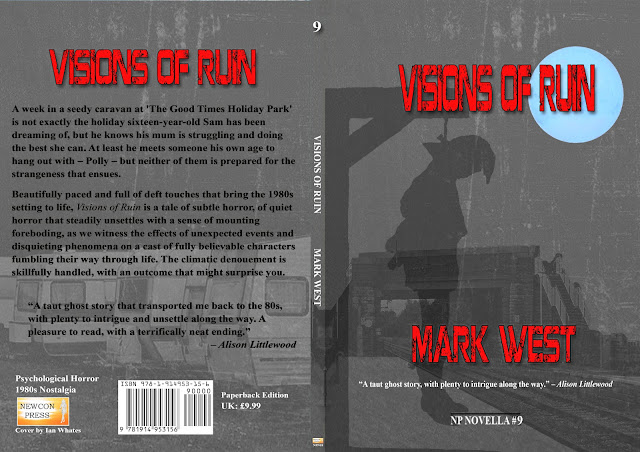
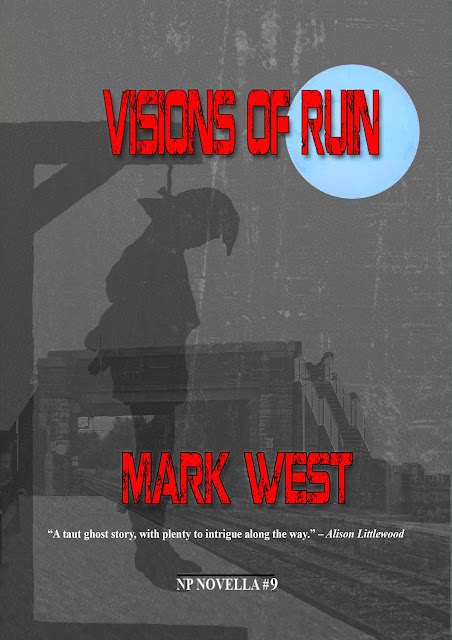
Visions Of Ruin is out now!

I'm pleased to announce that my horror novella, Visions Of Ruin, was published on March 30th by NewCon Press.

A week in a seedy caravan at 'The Good Times Holiday Park' is not exactly the holiday sixteen-year-old Sam has been dreaming of, but he knows his mum is struggling and doing the best she can. At least he meets someone his own age to hang out with – Polly – but neither of them is prepared for the strangeness that ensues. 

Beautifully paced and full of deft touches that bring the 1980s setting to life, Visions of Ruin is set during a rainy weekend at a caravan park on the edge of rundown seaside town. 


Me, on a Surrey bike, just outside Holimarine Corton, summer 1986.
Picture by Nick Duncan, who shared a lot of seaside adventures with me back then.
Having spent the last four years writing three mainstream thriller novels (the first two of which, DON'T GO BACK and
ONLY WATCHING YOU, have now been published by The Book Folks), I've only dipped a toe back into horror when people have asked for short stories.  But the genre is in my blood and when Ian Whates asked if I'd like to write a novella for him, I jumped at the chance - I like and respect him a lot and I'm proud to be associated with NewCon Press.

I started writing this just after I finished DON'T GO BACK and the idea took a little while to come together until I realised I could combine two of my apparent obsessions - teenagers in the 80s and a rundown east coast British seaside resort. Once that had clicked in my head I was off and running and the writing process itself (as well as drawing several maps of the caravan park central to the story) was hugely enjoyable and brought back a lot of good memories of holidays in the 80s.

The book is available as ebook and paperback editions and there's also a 60 copy Limited Edition  hardback which I thoroughly enjoyed signing the book plates for.
pictures by Dude
Being published by two companies has meant a bit of a "it's like buses" situation at the moment with my writing but I was really happy to see the early response to this and was thrilled when it hit Number 1 in the Hot New Releases (Teen & YA Ghost Stories) Amazon chart.
Amazon - 31/3/22

When he announced it in the NewCon Press newsletter, Ian wrote: "I am delighted to welcome Mark West back to NewCon Press' publishing schedule. Mark's short fiction has appeared in several of our anthologies over the years, including Ten Tall Tales and Hauntings, but this time he contributes a longer piece, Visions of Ruin, which will be the 9th entry in our NP Novella series. I rate this as Mark's most accomplished work to date, and was bowled over by it on first reading."

“A taut ghost story that transported me back to the 80s, with plenty to intrigue and unsettle along the way. A pleasure to read, with a terrifically neat ending.” 
 Alison Littlewood


Visions Of Ruin can be ordered directly from the NewCon Press website here.

£3.99 (ebook)
£9.99 (Paperback)
£19.99 (Signed Hardback, LTD ED)


Thanks to Ian Whates for both asking for and then enjoying the story enough to want to publish it, Nick Duncan for sharing all those adventures with me on the east coast in the 80s, Teika Marija Smits who helped push me to start, Alison Littlewood for her kind words and, as always, David Roberts & Pippa for the Friday Night Walks and the mammoth plotting sessions. 


Monday, 7 February 2022

Visions Of Ruin, from NewCon Press

I am pleased to announce my forthcoming horror novella, Visions Of Ruin, is now available for pre-order at the NewCon Press website. It will be published on March 30th 2022.

A week in a seedy caravan at 'The Good Times Holiday Park' is not exactly the holiday sixteen-year-old Sam has been dreaming of, but he knows his mum is struggling and doing the best she can. At least he meets someone his own age to hang out with – Polly – but neither of them is prepared for the strangeness that ensues. 

Beautifully paced and full of deft touches that bring the 1980s setting to life, Visions of Ruin is set during a rainy weekend at a caravan park on the edge of rundown seaside town. 


I wrote the novella last year, after finishing Jenny Was A Friend Of Mine (coming very soon from The Books Folks, as I wrote about here) and I'm really proud of it. Combining two of my apparent obsessions - the 80s and rundown British east coast seaside resorts - this mixes quiet supernatural horror (which, I hope, is chilling) along with hints of a teenage romance.

“A taut ghost story that transported me back to the 80s, with plenty to intrigue and unsettle along the way. A pleasure to read, with a terrifically neat ending.” 
Alison Littlewood

Visions Of Ruin is available in paperback and Limited Edition signed hardback and can be ordered directly from the NewCon Press website.

£9.99 (Paperback)
£19.99 (Signed Hardback, LTD ED)


Visions Of Ruin is also available as one quarter of the NewCon Novella Bundle 3, along with stories by Stephen Deas, Stewart Hotston and Ida Keogh. More details here.


Thanks to Ian Whates for both asking for and then enjoying the story enough to want to publish it, Nick Duncan for sharing all those adventures with me on the east coast in the 80s, Teika Marija Smits who helped push me to start and, as always, David Roberts for the Friday Night Walks and the mammoth plotting sessions. 

Monday, 29 November 2021

Visions Of Ruin, a horror novella

After it was revealed in the latest NewCon Press newsletter, I'm proud to announce that they will be publishing my horror novella, Visions Of Ruin, early in 2022.
Me, on a Surrey bike, just outside Holimarine Corton, summer 1986
Having spent the last four years writing three mainstream thriller novels (which are now going to be published by The Book Folks, as I wrote about here), I've only dipped a toe back into horror when people have asked for short stories.  But the genre is in my blood and when Ian Whates asked if I'd like to write a novella for him, I jumped at the chance - I like and respect him a lot and I'm proud to be associated with NewCon Press.

Ian writes in the newsletter:
"I am delighted to welcome Mark West back to NewCon Press' publishing schedule. Mark's short fiction has appeared in several of our anthologies over the years, including Ten Tall Tales and Hauntings, but this time he contributes a longer piece, Visions of Ruin, which will be the 8th entry in our NP Novella series. I rate this as Mark's most accomplished work to date, and was bowled over by it on first reading."

I began work on the novella whilst my latest thriller - Jenny Was A Friend Of Mine - was out on submission and it was a real delight to go back to horror, working in the novella format which I think suits the genre so well.  The idea took a little while to come together but once I realised it was set in the 80s, featuring teenagers in a rainy seaside town, I was off and running, the writing process itself (which involved me drawing several maps of the caravan park central to the story) being hugely enjoyable.


Ian, from the newsletter:
"A week in a caravan at 'The Good Times Holiday Park' at the edge of a rundown seaside town is not exactly the holiday sixteen-year-old Sam has been dreaming of, but he knows his mum is struggling and doing the best she can. At least he meets someone his own age to hang out with – Polly – but neither of them are prepared for the strangeness that ensues. Full of deft touches that bring the 1980s setting to life and populated with a cast of fully rounded characters that the reader can immediately relate to, Visions of Ruin will be released in early 2022."

I will post more details when I'm able, but I have to say, I'm looking forward to seeing Sam and Polly ride their Surrey bike out into the world.


Thanks to Ian for both asking for and then enjoying the story enough to want to publish it, Nick Duncan for taking the picture all those years ago and for our adventures on the east coast in the 80s, Teika Marija Smits who helped push me to start and, as always, David Roberts for the Friday Night Walks and the mammoth plotting sessions.

Monday, 22 March 2021

"The Exercise", a novella

My horror novella, The Exercise, is now available...

The Fens, August 1943.

Forced to seek medical attention, Corporal Ray Ward and his squad are warmly welcomed at Sinclair House, a rehabilitation unit dealing with solders suffering from shell-shock.

But Sinclair House isn’t what it appears to be. Out in the orchards, blood-chilling screams can be heard from the locked Nissen huts and the sheer volume of armed, clearly agitated military personnel around the property seems excessive. Ward and his men know something very wrong is happening at this isolated country estate and soon find themselves caught up in the middle of terrifying events…

An excerpt:

Robin had never been in Sinclair House but it looked very posh from his vantage point, hidden behind a bush.  It was old fashioned, stone-built, with fancy gargoyles on the roof and lots of windows, all X’d against bombing raids.  There were even some windows in the attic!  The wide expanse of lawn he could see wasn’t so posh though, it needed mowing.  To his left, a gravel drive led from the gate to the front door, which you had to go up steps to.  He’d seen some lorries drive up, dropping off and picking up whatever they were dropping off and picking up.  To his right was where the grounds really opened up - about a hundred yards away was the large chicken run and beyond that were four Nissen huts, just inside the tree-line of the orchard that ran to the back of the property.

Prisoners, people said.  Robin had never seen a German in real life, though he was sure he’d know one because they were snivelling cowards who shot you in the back, but the area was prepared for them and their attack, with several pill-boxes between here and the coast.  He and his gang sometimes played around them, especially when the younger Home Guard were on, because they remembered being children.  The older Home Guard were more serious and would quite happily chase off young boys, shouting threats and gesturing with rusty old bayonets strapped to their rifles.

Movement caught his eye and he ducked behind the bush as a lone soldier came from the drive, carrying a Sten gun.  He stopped when he reached the lawn, slung the gun over his shoulder and took a crumpled pack of smokes from his breast pocket.  Something made him twist around quickly and Robin watched him look this way and that, turning slowly, until he was seemingly satisfied enough to light his cigarette.  The harsh, sweet smell drifted over to Robin who inhaled hopefully.  A chicken squawked.
The soldier smoked his cigarette where he stood, finally stamping it out on the grass and throwing the tiny butt into the bush.  He coughed, took one last look around then walked back to the drive and out of sight.

Robin took that as his cue and, with his back to the wall, edged along until he’d cleared the bush.  The chicken coop was about fifty yards away and he could hear them, clucking at one another quietly.  There were some shapes on the grass he couldn’t quite make out properly but thought they looked like eggs.

Robin slipped his knapsack off and, crouching low, duck-walked to the coop.  He was halfway there when he heard someone shout - he couldn’t make out what they said, but it didn’t sound happy.  He looked up towards the Nissen huts.  People seemed to be moving about.  There was another shout, louder this time and unmistakably angry.  Running footsteps sounded on the gravel behind him.  He was caught in the middle.

“Bollocks,” he said, feeling a terrible cold sweat on his forehead.

More footsteps on the gravel.  It wouldn’t be long until they reached the lawn and saw him.  There was an angry shout from the Nissen huts and something else, a sound like a crowd at a football match.  Robin pushed away from the coop and its potential eggs, aiming for the bush.

“Stop!” someone yelled and he froze, his heart thudding in his chest and wrists.  What would he say, what could he say?  This was the cane, for sure and probably a proper leathering from Dad too.

“I said stop!” yelled the same voice.  Robin hadn’t moved, which meant he hadn’t been seen so he quickly pushed himself back.

A single shot was fired, which filled the night with sound and made the silence that followed it even noisier.  Nobody moved on the gravel but he could hear someone running, the heavy thud of their step indicating they were moving fast.  A shape came towards him from the orchard, arms flailing as if trying to keep balance.

“I said stop!” yelled the voice, “or I’ll fire.”

The runner kept moving and the guns responded.  There were several single shots, probably from Lee Enfield number fours.  Robin knew his guns, he knew what they sounded like and prided himself on his knowledge.

The Sten guns rattled into life.  Several 9mm bullets thudded into the wall behind Robin, showering him with stone dust.  He flinched, covered his face.

The runner bumped his leg against the side of the chicken run, the limb flicking out at an odd angle and cartwheeling the man across the lawn.  More bullets hit the lawn, ripping holes into the grass.  Robin was three feet away from the bush and, it seemed, still in the firing line.

A searchlight burst into life from the roof, its beam quickly directed onto the lawn.  Robin closed his eyes against the glare but the imprint of the man running towards him, his left leg moving at an impossible angle, stayed with him.  There were more shouts, more gunshots, then someone yelled “There’s a child!”

* * *
The Exercise began life in January 2015, when I was invited to contribute to a wartime anthology and - having never written a war story before - I readily agreed to contribute.  I came up with the basic plot on an evening walk then sat down with Mum & Dad (he’s a real WW2 buff) to ask him some technical questions and throw around more ideas (my Mum came up with the concept of how they get to the house).

The characters in the squad took a while to gel in my head but, once they had, they fitted together well (and allowed for some nice little bits of comedy) and the writing was quite fast (for me) and generally good fun.  

The anthology, Darker Battlefields, was eventually launched at Edge-Lit 5 in Derby in 2016 (I wrote about it here).  Published by Terry Grimwood’s theEXAGGERATEDpress and edited by Adrian Chamberlin, it featured four other novellas and a cracking Ben Baldwin cover but, for whatever reason, didn’t gain much traction.  I’ve always thought that was a real shame, which led me on the path to re-publishing this.

* * *
The Exercise went up for pre-order last week and thanks to everyone who RT'd my Tweets and shared my Facebook update (I really appreciate your support!), it had quite a good day for itself, gracing the upper half of the Amazon Best Sellers (Horror Short Stories) and hitting Number 1 in the Hot New Releases.  Easily pleased, I was well chuffed!

The Exercise, published by PenMan Press
Revised text
Story Notes
Acknowledgements

Universal book link - https://pge.me/TheExerciseMarkWest


Monday, 15 March 2021

"The Exercise" available to pre-order

 Out next Monday, my horror novella, The Exercise, is now available to pre-order as an ebook...

The Fens, August 1943.

Forced to seek medical attention, Corporal Ray Ward and his squad are warmly welcomed at Sinclair House, a rehabilitation unit dealing with solders suffering from shell-shock.

But Sinclair House isn’t what it appears to be. Out in the orchards, blood-chilling screams can be heard from the locked Nissen huts and the sheer volume of armed, clearly agitated military personnel around the property seems excessive. Ward and his men know something very wrong is happening at this isolated country estate and soon find themselves caught up in the middle of terrifying events…

* * *

A horror novella from Mark West, author of The Mill and DriveThe Exercise was originally published in Darker Battlefields from theEXAGERRATEDpress in 2016.  It now appears, in a revised version, from PenMan Press, available in both ebook and paperback editions.

* * * 
Mark West lives in Northamptonshire with his wife Alison and their son Matthew.  Since discovering the small press in 1998 he has published over eighty short stories, two novels, a novelette, a chapbook, two collections and six novellas  (one of which, Drive, was nominated for a British Fantasy Award).  He has more short stories forthcoming and is currently working on a crime/thriller novel.  

Away from writing, he enjoys reading, walking, watching films and playing Dudeball with his son.

He can be contacted through his website at www.markwest.org.uk and is also on Twitter as @MarkEWest


Monday, 13 April 2020

Glorious Beasts: A Q&A with Gary McMahon

Gary McMahon & I have known one another for a long time now and I'm a big fan of his writing.  When Peter Mark May told me he was publishing a new McMahon novella (originally scheduled to launch at Stokercon this coming weekend, before the world went into Lockdown) I was thrilled, especially since Pete tends to send me Hersham Horror books to read through before they're released.  So I read the novella and loved it, got in touch with Gary to tell him and he happily agreed to answer some questions for me.

Cable makes his living tracking down bad men. His young son, Walker, is unable to speak, but the boy notices signs and tracks that others fail to see. When they offer to help a woman whose baby was snatched in the night, they realise they might be searching the wilderness for something unlike anything they've seen before. 

When men become beasts, something ancient awakes, and things worse than death roam the land.


MW:   The novella is a tough read at times, with plenty of your trademark bleakness to it. Are you finding that kind of style easier to write as you get older or harder?

GM:   It seems to me that the older I get, the bleaker my worldview becomes. What’s changed is my acceptance of it. I no longer fight that pessimistic side of me; instead, I embrace it. I’m never purposefully trying to be “dark”. I’ve always just been the kind of guy who prefers the sad songs...

People always seem to go on about how bleak my work is, and to be honest it’s become a bit tiresome to me. I don’t think my writing is bleak. It’s sad. It’s melancholy. Shades of grey.

I personally believe there’s a lot of light in my work: a lot of heart, a lot of soul, and a lot of humanity. But a reader has to work for it. They aren’t getting it spoon-fed from me. To get to the light, they have to walk through a lot of darkness.

The world isn’t a very nice place. All people are not inherently good. Love is rarely enough to save you. Your scars won’t fade entirely.

It isn’t my job to reassure you. I’d rather deal in these harsh truths in my work than pretend the darkness doesn’t exist, or that it can be vanquished for good. All we can ever do is push it back for a while, but it always returns.

MW:   I know it’s difficult to pin a story down to a single image, but where did this come from?

GM:   I can tell you exactly which image came first, but it would be a spoiler. It’s the cruellest image in the story, the one that will hopefully make people wince when they read it.

Then I started thinking I’d like to tie in some of the mythology surrounding those big cats some people think are roaming the English countryside. The Beast of Bodmin and its ilk. I’d always wanted to use that in a story.

If I’m honest, a lot of Brexit paranoia probably found its way into the tale. We always use what’s happening around us, don’t we? It’s all meat for the beast.
With the Secret Horror Cabal (we have a sarky Messenger group) at FCon Scaborough in 2016 (see my report here) with me, Alison Littlewood, Gary Fry and Gary McMahon - sarcasm not pictured

MW:   The world is thoroughly well realised (if fleetingly described), did you do much research to get the look and feel of it?

GM:   I did no research whatsoever. I just wanted a world that was slowly winding down. Decades before, there’d been a plague that had wiped out half the population. The ones who survived abandoned a lot of modern technology and started to turn insular and feudal, fighting tribal wars. After those wars were over, beliefs began to slip back to those of medieval times. Things that were once local folklore became real. Witches. Warlocks. Mythical beasts like the big cat.

In this story, the world stopped advancing in 1974. That’s when The Plague Years began. Home computers hadn’t yet been invented. There was no internet. No mobile phones. None of that stuff.

There’s a lot of Mad Max in the setting, and The Hills Have Eyes, and The Road. Julia Leigh’s superb novel The Hunter. A book about the Sawney Bean clan I read when I was a kid. The structure was borrowed from the film Bone Tomahawk. I think it’s safe to say my story wears it’s influences on its sleeve.

MW:   Can you see yourself writing more in this world?

GM:   Oh, definitely. I’d actually like to write a series of novellas set in this world.

I’m sick of having to write mobile phones, the internet, and iPads into stories. It’s boring. I love the simplicity of this stripped back, hard-scrabble place, the characters that live in it, the limitless possibilities of telling simple stories that actually have a lot of substance behind them.
At Sledge-Lit in November 2016 (see my report here) with Gary and Stephen Bacon
MW:   The novella has a brisk style, with wonderfully clipped dialogue and tells the story quickly and precisely. Do you prefer to work in this format, the short story or the novel or does it totally depend on the tale?

GM:   I find it tough to write novels these days. I think I burned myself out on the novel format a few years ago, when I committed to writing so damn many of them in a short space of time. I was also burned by poor sales. You bleed onto the page and nobody cares. It’s a harsh lesson to learn.

Glorious Beasts needed to be told in a spare fashion. The characters speak in a clipped manner because this is a hard, no-nonsense world. There’s no time for messing about with unnecessary niceties: these damaged people are all focused on survival.

I’ve always liked the novella format. I think it suits my clipped prose style. And it isn’t as daunting as writing a novel, as holding that whole world inside your head.

Novel writing, to me, feels so much like a form of madness. I’m a little scared to get back to that mindset. I will go back there, of course, but I’m not in a hurry. I’ll let it occur naturally, once I find a story that can’t be told any other way. I’m a great believer in the story dictating the form. I know there are more novel-length stories inside me, they just haven’t surfaced yet.


For more information on Gary and his writing, check out his blog here.


Monday, 20 May 2019

Closer Still, by Richard Farren Barber (a review and Q&A)

In a new edition of the occasional series, I want to tell you about a book I've read and loved, which I think adds to the horror genre and that I think you'll enjoy if you're a fan.
Keep your friend close, and your enemies closer still.
- Origin contested

“Closer Still is about childhood friends and childhood enemies. It is a story about how the two are often not as far apart as one might believe. It is my thoughts on the strength of children to navigate an environment in which they are often powerless. It is about love and betrayal. The casual pain inflicted by friends. It is the visceral cry of youth against the injustice of life.”

Rachel is fifteen, burdened with the nickname ‘Kooky’ and seemingly ostracised from a small group of girls she was once part of.  To make matters worse, she’s being haunted by her best friend Katie, who sits or stands quietly in the corner of Rachel’s bedroom.  As time goes on and Katie discovers more powers - she spends a long time trying to roll a pencil over a dresser top - Rachel’s ex-friends begin an insidious campaign of bullying - online and in person - that serve to make Rachel ever more isolated and alone.  She’s cornered in cloak rooms, harassed in corridors and chased down the street, the latter incident videoed to go viral through the school.  Although this brings in the authority figures - parents and teachers - her reluctance to talk and the natural reserve/disdain of a fifteen-year old prevents any kind of breakthrough.  And meanwhile, the bullying gets worse and Katie’s presence becomes ever stronger.

I thoroughly enjoyed Barber’s previous novella Perfect Darkness, Perfect Silence and this is equally as good, if poles apart.  A perfectly paced ghost story that turns up its horror - both real and supernatural - as it goes, this benefits greatly from having Rachel as the narrator (unreliable at times), with Barber capturing her voice exceptionally well.  School life feels real and raw with the sense of being alone in a crowded classroom or playground, the demeanour of the teachers which can be threatening or benign but never fully on your side, the smell of the rooms and corridors, the terror of being trapped in a toilet block.  At home, we see very little of Rachel’s life other than in her bedroom, where parents only occasionally intrude but the spectre of Katie is often there and watching.  The supernatural hand is played well, with Katie appearing early enough that we quickly accept she’s a part of Rachel’s world and as the terror and threat ramp up, she becomes evermore frightening.  The ex-friends are equally well realised and never fully painted to be the villains of the piece.  In lesser hands, ringleader Sarah would be the stereotypical bully but her character is developed to show different sides and angles, while hangers-on Francine and Joanna find themselves in a situation they don’t want to be in but can’t seem to get out of.  As all these lives spiral downwards, it seems that Katie has a plan in mind and when her retribution is unleashed, it’s brisk and harsh and clearly building to a bigger picture.

Exceptionally well written, with a great sense for location and atmosphere, this is a perfectly realised ghost story and I would highly recommend it.

* * *
I enjoyed the story so much, I asked Richard some questions about it and he was gracious enough to answer.
Richard, Stephen Bacon, me and Wayne Parkin, doing a boyband pose
on Scarborough seafront during FantasyCon weekend, September 2016.
You can read a full report of the convention here
MW:   Can you give me some idea as to where this came from?  And bearing in mind how perfectly the cover title (and quote) work, did that come early in the process or later?

RFB:  The novel was originally going to be a script, and it goes back many years. I started it to submit to the BBC Writers’ Room in 2009. It was called Wallflowers and I still have the original 31 pages of script, and that taught me one thing; writing a script is not the same as writing prose! It’s a whole different technique and skillset (and I have no doubt there are script writers the world over who would read this and roll their eyes) Although I don’t remember actually submitting it, I must have done as I still have the receipt from the BBC.

By 2014, when I came back to the idea and decided that I wanted to write it as a novella, I had the title of Closer Still which came directly from the quote. (Although I had to Google the origin of the quote!).  I did have an idea that Closer Still would be the first of two novellas, with the second called Still Closer, which would tell the story from Katie’s viewpoint, because I think Katie has a lot to say and I have a lot of sympathy for her. I even wrote the start of an outline but I haven't gone back to it yet. Maybe one day...

MW:   You treat the supernatural almost as a normal occurrence in this, with Rachel fully accepting it.  Did you worry about how this would come across (it’s works very well, in my opinion)?

RFB:  One of the things I really like playing with in fiction is casting the supernatural as natural; so in Closer Still Rachel simply accepts that Katie is a ghost and has the usual curiosity about what being dead really feels like.

I’m fascinated by the idea that quite often “stuff” is out in the open and we just don’t know it because we don’t really know to notice it. That idea that the best place to hide things is in plain view. I often wonder what is behind the small door that you walk past every day, why the windows of that house are boarded up.

It’s a subject I’ve come back to with my recent novel The Living and The Lost - where again it starts from the basis that ghosts are a simple fact of life (I do like ghost stories!) and runs with it from there.

I don’t think I really worried about how it would come across, because my idea was that either you’re able to suspend disbelief for the duration of the story or you’re probably reading the wrong genre. Interestingly, I heard Joe Hill talk recently and he said his approach was that if the story had anything unusual or difficult to digest, get it out at the very start because the readers will be more accepting of it.

MW:   Obvious question but I’m intrigued - have you ever had a supernatural experience?

RFB:  I haven’t had a supernatural experience. The closest I’ve come to was going into St Mary’s Close in Edinburgh and having a ghost tour in the semi-darkness. By the end of the tour I was living on the edge of my nerves – the place was genuinely eerie. I found myself at the very back of the group and constantly looking over my shoulder into the darkness. Did I see anything moving behind me? I don’t think so, but I realised that if anyone had put a hand on my shoulder I would have screamed loud enough to wake the dead.

MW:   I loved the school location and found it reminded me a lot of my own.  But since you & I left full-time education during the 80s, how much research did you have to do?

RFB:  Thank you! I’ll confess I didn’t do any research. The school is based on my memories of the schools I attended back in the 80s. In many respects I have an awful memory, but I seem to have a knack for remembering places.  Just the other week I was discussing this with someone and saying I think if I went back to my secondary school now, and if it hadn’t changed, I think I could walk around the site without getting lost. If I close my eyes now I can see whole sections of the corridors. But if you asked me to name who was in my class or almost anything about Chemistry then I wouldn’t have a clue.

MW:   Rachel carries the novella and I found her to exceptionally well realised.  Was writing from her pov (bearing in mind you’re neither female or in your teens) ever daunting?

RFB:  It was definitely a challenge to write a main character where the age and gender were so far removed from my own – and therefore the life experiences and attitudes would be different. It was a deliberate decision to write a piece of fiction from a view point other than middle-aged-white-man. I’m not sure how well it reflects true life, but I tried to tap into that the sense of being an outsider. The feelings of injustice and guilt Rachel is dealing with are relatable to all of us.


You can find Richard online at Twitter here

Monday, 7 January 2019

Hell Ship, by Benedict J. Jones (a review and Q&A)

In a new edition of the occasional series, I want to tell you about a book I've read and loved, which I think adds to the horror genre and that I think you'll enjoy if you're a fan.
1944, The Malacca Straights; Blood slicks the deck of a Japanese ship as a terrible ritual is enacting to aid the failing Imperial Forces against the Allies. The ritual rends the very fabric of our world giving access to another realm beyond the ken of man.

Nine survivors from the torpedoed Empire Carew are left adrift in a lifeboat but after weeks in the water they find haven on an abandoned ship they find floating in a strange fog – The Shinjuku Maru.

Nine souls are heading straight for hell.

The Shinjuku Maru has been there before…

The Empire Carew is torpedoed in The Malacca Straights in 1944.  Nine survivors make it to a lifeboat (a motley crew comprising three seasoned sailors, a rookie officer, a radio operator, a singer and her manager, a cook and an Australian nurse) but then spend weeks existing on it with no supplies until they come across The Shinjuku Maru, a ship floating in a strange fog.  They board it, to find blood on the decks and no crew on board and then things start to go from bad to worse.

I like variety in my horror and have no problem mixing the quieter, supernatural stuff with the lurid, over-the-top style so beloved of paperback writers in the 70s and 80s and in that regard, Jones is my ideal writer.  Having read his Slaughter Beach, a cracking piece of pulp, a few years ago and thoroughly enjoyed it, I was looking forward to this and wasn’t disappointed, even though it’s a completely different beast.  Opening with a harsh and harrowing prologue, it sets about introducing the crew of the lifeboat and the characters leap off the page, instantly living and breathing.  We share their predicament - resorting to shooting seagulls to drink the blood before they eat them - and it’s a relief when they finally spot the ship.  Here, though, the novella really moves into horror territory and Jones makes the best of his restricted location, ramping up the sense of tension, isolation and claustrophobia, while hinting at darker forces gathering in the shadows in the corners of rooms.  When hell finally does break loose - and it properly does - the pace whips you through the pages, as our crew is split up and picked off, featuring bone crunching violence that is brutal, realistic and never gratuitous.

Scary, thrilling, often amusing (especially in the interplay between some of the characters) but above all relentless, this has a great pace and a superb sense of location, which is well realised and maintained.  If you’re looking for a grim and gruesome horror novella, this is ideal and I highly recommend it.

* * *

I enjoyed the story so much, I decided to ask Ben some questions about it and he was gracious enough to answer.

MW:   You’ve included a powerful author’s note, stating this is a fiction but based on atrocities that occurred during World War Two, but what led you to write the novella?

BJ:   I actually came across the atrocities while researching the basic idea for Hell Ship – which was initially to be set on a German surface raider in the Second World War. I quickly realised that setting it in the far east would work better. The more I read of the massacres and also of the “hell ships” used to transport allied POWs the more I was struck by the question of why. In some ways the rituals are a way of me trying to give a “why” to it all even though none really exists and it is simply an illustration of how inhumane man can be to his fellow man in certain times.

MW:   How much research was involved?

BJ:   A fair bit. Some things I knew already from reading and previous research but I was drawn to find out more about the merchant seamen during World War two. My family is originally from the north east of England and we have strong ties to the Merchant Navy, as well as the ship building industry and the Royal Navy. Once I started researching shipwreck survivors I came across some really interesting accounts and all that fed into Hell Ship – including that of Poon Lim who spent 133 days adrift.

MW:   The prologue, in particular, is gruelling.  How uncomfortable was that to research and write?

BJ:   It was imagining those nightmarish conditions that really spurred me on to write the story. It just seemed so raw and visceral, and once I tried to put myself in the heads that set me off writing. There was very little re-writing done to the prologue once I had it down. I was lucky that it was just one of those pieces that “wanted” to come out onto the page and I’m delighted by the way it has been affecting readers.

MW:   Your characters leap off the page - which of them was your favourite to write?

BJ:   Probably Busby. Originally Connolly was intended to be more of a “hero” type but as the story came together he faded into the background somewhat as other characters pushed to the fore. I really like the relationship between Busby and Snell – one of the early scenes between them on the life boat came to me fully formed and I always knew where that pair were headed. Lily and Conrad were another pair of characters that I enjoyed exploring but their relationship was somewhat different, revealing itself to me as I wrote it rather than something I had thought out beforehand.

MW:   I liked the Busby/Snell rapport too and thought that worked very well.  Now The Shinjuku Maru is an excellent location.  Did you base it on a real ship, or did it all come from your imagination (and if so, did you create a map of it)?

BJ:   It was a composite of several of the merchant ships that were really used by the Japanese to transport prisoners. I think the main design came from a refrigerator ship. I did starts making a map for it but soon realised that as things turned “weird” the Shinjuku Maru was a bit more fluid that most ships anyway…

MW:   What’s next for you?

BJ:   There’s a new Charlie Bars novel slated for release early in 2019 and I am beavering away on various other projects as well.

* * *

Benedict J. Jones is a writer of crime, horror and westerns from south-east London.  Perhaps best known for the Charlie Bars series of neo-noir novels and the splatter punk novella Slaughter Beach, he can be found online at benedictjones.com and is great company at Cons.


Monday, 19 November 2018

The Smallest Of Things, by Ian Whates (a review and Q&A)

In a new edition of the occasional series, I want to tell you about a book I've read and loved, which I think adds to the genre (sci-fi thriller, in this case) and that I think you'll enjoy if you're a fan.
There are many Londons. From pomp to sleaze, from sophistication to dark corruption, Chris knows them all. A fixer with a particular set of skills, he can step between realities, piercing the thin veils that separate one London from another to find objects or locate people that have fallen between the cracks.

When a close friend, Claire, comes to him fearing for her life he is forced to use his abilities as never before, fleeing with her through a series of ever stranger Londons, trying to keep one step ahead of the men who murdered her boyfriend and are now hunting her.   

At some point, Chris hopes that he and Claire can pause long enough to figure out why these mysterious figures from another London want her dead, but right now they’re too busy simply trying to stay alive.

Taking as its central conceit that there are multiple Londons, co-existing in different dimensions and each distinctive from the other, this follows Chris, who can travel between them.  He’s a fixer, a troubleshooter who can find people or things that have fallen between the cracks, a sort-of Robin Hood (as one character calls him).  When his old friend Claire gets in touch, fearing for her life as she’s just witnessed her boyfriend being murdered by men in brown coats, he’s called upon to help her escape from these mysterious strangers who will seemingly stop at nothing to catch her.

Told with skill and poise, this paints a picture of modern London quickly and vividly, casting dark shadows onto places we all see every day.  With Chris and Claire, fully formed characters who leap off the page as soon as they’re introduced, we drop straight into the story and the pace doesn’t let up, slowly revealing plot points that build brilliantly.  The men in brown coats are cleverly used and the cast of supporting characters, who assist Chris in various ways, are given just enough history to make an impression without clouding the main story.  As for the Chris and Claire backstory (I’d love to see more of it, to be honest), that feels fully formed and just out of sight, with plenty of mentions of Chris’ previous jobs that all sound as exciting as this one.  The different Londons are excellent - a high-tech one with wide roads and trams, another a smog-filled Dickensian nightmare and others, including ones very similar to ours - and again feel fully formed, though they’re not revelled in, there’s no “look at what I made here” indulgence, we see just enough to realise we’re in a different place and then we’re off again.  Filled with well realised set pieces, some terrific action scenes and a nice line in humour, this works on every level and is greatly assisted by the brisk pacing (though I’d have preferred it to be much longer).  An excellent sci-fi thriller, this is a great read (with a brilliant last line) and I’d highly recommend it.

* * *

I enjoyed the story so much, I decided to ask Ian some questions about it and he was gracious enough to answer.

MW:   What’s the story behind this novella and how did it come about because it feels like we’re seeing something that has a very complete backstory.  What came first, Chris or the concept of the alternate Londons?

IW:   Chris came about a few years ago, following a day of wandering around numerous shops in central London. While my better half, Helen, continued with the retail therapy, I sought refuge in a pub close to Covent Garden, where I began jotting down notes on the various characters we’d encountered during the day.

As I did so, I reflected on the manner in which London possesses so many different faces: the political hub of the nation, the financial centre, the home of pomp and ceremony, celebrity restaurants and high-end dining, exclusive boutiques and prestigious department stores, cockney heritage and the spirit of the Blitz, nightclubs and all-night bars, markets and street entertainers, red buses and tourist attractions, and so on… I found myself thinking: what if there were other Londons, less apparent, more difficult to find? Londons that brush alongside the city we know without quite intersecting, hidden from view by the facets we’re so familiar with that catch the light and sparkle.

Those notes, scribbled while sipping a pint or two of Young’s Special, became a story called Knowing How to Look, which marked Chris’ debut. It featured a succubus and a curse, but I realised immediately that this premise of different Londons would enable me to play around with aspects of science fiction, fantasy and horror, mixing and matching as I chose, because there are an infinite number of alternative Londons and anything could be possible somewhere. Making a cameo appearance in this first story was a character called Claire, based on a tall, vibrant young woman we had come across earlier that day serving in a Berwick Street shop …

MW:   PS have done a fantastic job with the novella.  How much fun was the launch at FantasyCon?

IW:   Yes, PS have done their customary fabulous job, and I must thank everyone involved; also huge kudos to Ben Baldwin, who produced the cover art. Nicky Crowther at PS first proposed a map of London tearing to allow a man to step through. I then added the suggestion that part of the map could be in flames, as if lit by a match, and Ben ran with that, taking our suggestions and pushing them one step further. I love the result, which couldn’t be more appropriate.

The launch at Fantasycon was great fun. Thankfully, not everyone attending came up only for Ramsey Campbell and Stephen Volk’s signatures, and sufficient copies of The Smallest of Things were purchased to keep me busy.

MW:   A lot of Chris’ previous adventures are alluded to in the novella, have you written any of these?

IW:   This is actually the fifth of Chris’ adventures I’ve written (though the first at this length). One of the others, frustratingly, has been lost somewhere along the way without ever being submitted for publication. The first story, in which Chris attempts to save his sister’s life, is the safest in some senses, because it’s set entirely in our reality, although it relies on interaction with beings from other Londons (it’s currently available in my first collection Growing Pains). I wrote the second, which involves the Green Man (the creature of folk lore, not the pub), for an Alchemy Press anthology, and that’s now in my third collection Dark Travellings. The fourth, The Yin Yang Crescent takes us to the London that’s home to Jed, who has a cameo in the new novella. That one sold to an American publication a few years ago but for various reasons they never published it. I subsequently sold the Spanish language rights and it featured earlier this year in the excellent Windumanoth magazine, but has yet to appear in English.

Claire doesn’t feature in either of these tales, but the (ahem) missing story centres on a gig by her band Quiet Catastrophe. The frustrating aspect of this being lost somewhere between computer change-overs is that I wasn’t convinced the idea would work as a story. It did, and I was quite chuffed by the result. My fear is that if I try to rewrite the piece, I’ll never get it to work again.

MW:   The alternate Londons are beautifully constructed though you don’t dwell on your world building, we see them as briskly as the characters do which is fantastic.  How many Londons did you create and what drove you to use the ones you chose?

IW:   To be honest, I conjure up the different Londons as needed. I spent six years attending school in the City, so have a strong affinity and reasonable familiarity with London (and during that period won the Lord Mayor’s Prize for English, open to every school in the capital, with an essay called ‘London: the Living City’, which drew comparisons between London and a living organism). Yes, the city changes constantly and often dramatically, but I can still recognise the London I know and adapt my knowledge of it to each altered incarnation.

With the Londons that Chris and Claire encounter in The Smallest of Things, I wanted to depict contrasts, so I started with a glimpse of a city very like ours but where trams are an established form of public transport, and followed that with a version where the industrial revolution still holds sway, where pollution is rife and the infamous London smogs are still a thing, another hi-tech version where human transport is apparent but no person is ever seen (a tip of the hat towards the concept of technology distancing us from our own humanity) and finally one where prejudice and suspicion of ‘others’ leads to mob rule.

MW:   The action sequences are gripping, punchy and well-paced, did you have to do a lot of planning with them?

IW:   Thank you, I’m glad they work. Most of the action centres on two chase sequences. Knowing there were to be two of these – the first when Chris first meets up with Claire and learns of the people hunting her, the second after they’re surprised by a trio of ‘brown coats’ at Claire’s flat – I wanted to avoid repetition by making them markedly different. Escalation was important: the first had to be sufficiently tense to hold the reader’s attention, but the second had to out do it in every way; so I kept the first to this reality, drawing on Chris’ knowledge of London and its people. The second was where I let rip, and had Claire and Chris pursued across a series of starkly contrasting realities.

In the story, Chris utilises a number of trinkets he’s accumulated during various jobs, including hi-tech gadgets and lo-tech charms. For the story to work as intended, I needed to ensure that my villains the Faramund (brown coats) were biologically different from us in a subtle way, and I wanted to make that difference scientifically plausible. To ensure it was, I ran my thinking past a former member of the Northampton SF Writers Group, Dr. Steve Longworth (an MD), and his input was invaluable in getting that aspect right.

MW:   I liked the characters of Chris and Claire a great deal, partly because of their close friendship and shared history.  Can we expect to see more of them?

IW:   That’s certainly the intention (and thank you, I’m fond of them too). I’m delighted to say the PS Publishing have commissioned a new novella to follow on from The Smallest of Things, which I’ll be writing next year, and, you never know, I may yet bite the bullet and re-write that lost story.

MW:   What’s next for you?

IW:   All manner of projects with NewCon Press – I’m currently committed to publishing 35 titles over the next two years, a mix of novels, novellas, anthologies, and single author collections. At the same time, I’m determined to find space for my own writing. I have a commissioned novella to finish for Shoreline of Infinity (this one is fantasy); my fourth short story collection (in English – I also have another collection out in Spanish) is due from Luna Press next summer; I’m determined to finish the third volume of my Dark Angels space opera trilogy of novels for release next year; and I have a literary fantasy novel called Twelve Faces of Beauty sitting with my agent, which he’s asked me to revise but I simply haven’t found time to as yet. Doubtless there’ll be one or two short stories along the way as well, but I reckon that should be enough to keep me occupied.

* * *
Ian at FantasyCon 2018 in Chester, at the Smallest Of Things PS launch
Ian lives in a sleepy Cambridgeshire village with his partner, Helen, and a manic cocker spaniel called Bundle. A writer and editor of science fiction, fantasy, and occasionally horror, he is the author of seven novels (four space opera and three urban fantasy with steampunk overtones), the co-author of two more (military SF), has seen some seventy of his short stories published in a variety of venues, and has edited more than thirty anthologies. His work has been shortlisted for the Philip K. Dick Award and twice for BSFA Awards. His novel Pelquin’s Comet, first in the Dark Angels sequence, was an Amazon UK #1 best seller, and his work has been translated into Spanish, German, Hungarian, Czech and Greek. His fourth short story collection in English, Wourism and Other Stories, will appear via Luna Press in 2019.

Ian served a term as a director of SFWA (the Science Fiction Writers of America) and is a director of the BSFA (the British Science Fiction Association) an organisation he chaired for five years.  In 2006, Ian founded multiple award-winning independent publisher NewCon Press by accident, and he continues to be baffled by the number of titles the imprint has produced.

Ian can be found online at www.ianwhates.co.uk


Monday, 5 November 2018

The Last Temptation Of Dr Valentine, by John Llewellyn Probert (a review)

In a new edition of the occasional series, I want to tell you about a book I've read and loved, which I think adds to the horror genre and that I think you'll enjoy if you're a fan.
Six Years Ago…

The city of Bristol is rocked by a series of horrific murders, each more gruesome and outrageous than the last, and all in the style of horror films starring Vincent Price.

Four Years Ago…

The journalists who wrote about the case begin to die horribly, this time in the style of Hammer horror movies.

Now…

A Hollywood film company has arrived in Bristol to make a movie about the murders. Nicolas Cage is planned to star, and the screenplay bears little resemblance to what actually happened.

And someone isn’t happy about any of that. Someone who plans to use some of the most creative death scenes in classic British horror films to show these modern
film-makers just what a terrible mistake they have made.

The world’s most resourceful and flamboyant maniac returns…


John Llewellyn Probert is incapable of telling a bad story and his highly distinctive voice (both in real life, at one of his readings, as well as in print) is a real treat for a reader especially if you like your horror on the 'broader' end of the scale.

John has "been watching British-made horror films since he was ten years old, when he saw Dr Phibes Rises Again (1972) and Witchfinder General (1968) on a Vincent Price season on ATV. He was probably a bit too young for that second film, but the first influenced him to an extent that is still being felt by readers to this day..." and so he & I mesh wonderfully.  When I edited my anthology, Anatomy Of Death, which featured stories inspired by British horror from the 70s, we were on common ground and he supplied me with a wonderful tale that fully embraced the Hammer ethos.

Dr Edward Valentine, a surgeon driven to madness, is probably my favourite creation of his and appeared in two previous volumes, The Nine Deaths Of Dr Valentine and The Hammer Of Dr Valentine, both of which I thoroughly enjoyed.  Now republished in an omnibus edition by Black Shuck Books, I was lucky enough to pick up the Last Temptation hardback at FantasyCon and also got to see John's reading.

This fantastic novella featuring “the world’s most resourceful and flamboyant maniac” is not only a worthy addition to the canon but (as much as I loved the other two) probably pips them both as the best of the bunch.  This time around the good doctor bumps off his victims in and around Bristol (with a wonderful interlude to Weston Super Mare) and it’s a marvellous feast of British horror movies from the 50’s to the 70’s (with a nice touch to a much more modern film as well).  Told with great wit and style, this delirious tale of murder and mayhem races from one set piece to the next, each more inventive than the last, as Valentine attempts to up the body count while avoiding the attentions of his long-suffering nemesis, Inspector Longdon, brought out of retirement to take on the case by DS Jenny Newham.  Firing on all cylinders - in-jokes are salted away on almost every page and I wish the chapter titles were listed to show how funny they are - and told with an astonishingly quick pace, John has somehow managed to convey a film of this era in print and I read most of it with a grin on my face.  If you like your horror quiet and studious then it’s probably not for you, but if you’re prepared to throw your lot in with a writer who not only knows his stuff but can convey it perfectly, you’re going to have a great time.  Very much recommended.

The book also features "The Last Afterword Of Dr Valentine", where John lists the films that are homaged in the text, with a nice mixture of review, opinion and autobiography - and makes me wish I'd known the writer when we were kids (when I was ten or eleven, I didn't know anyone else who loved this kind of horror film).

I'll leave you with this, which appears on page 92 and - to me - perfectly sums up the tone of the piece.

"Well I think you're right on both counts, Newham.  We've got a crazed producer intent on risking his and his team's lives to finish his project, and a crazed killer intent on stopping them in the style of old British horror movies from the 1970s, but apart from that we have no idea how or where or when he might strike next."

"So what do we do next, sir?"

The sun was up, now.  Longdon pointed to a cafe on the corner.

"Breakfast."

And now you can experience the full Probert experience as John's wife, Thana Niveau, filmed his FantasyCon reading - and I'm participating fully in all that laughter...