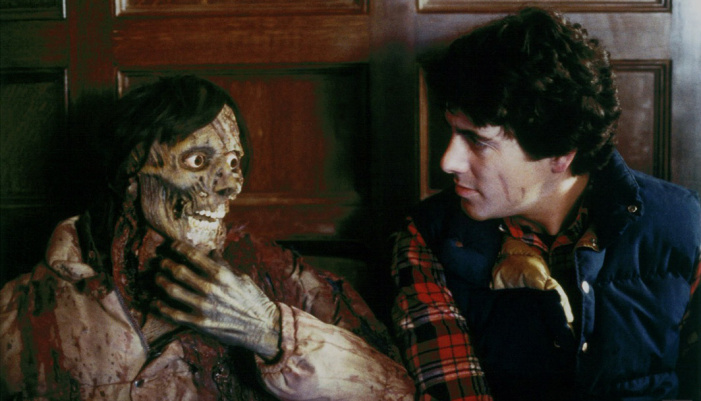
An American Werewolf In London opened in the UK on 12th November 1981 (after its debut at the London Film Festival on 8th November), following its release in the US on 21st August. It was written and directed by John Landis, produced by George Folsey Jr and edited by Malcolm Campbell. Rick Baker (who I wrote an appreciation of here) supervised the special effects make-up, Robert Paynter was the director of photography, Elmer Bernstein provided the music and Deborah Nadoolman (Landis’ wife) was the costume designer.
John Landis came up with the idea whilst working as a production assistant on Kelly’s Heroes in Yugoslavia in 1969. As he and a Yugoslavian crew member were driving to set, they came across a group of gypsies who were performing a ritual, burying the corpse feet first and wrapped in garlic so it couldn’t rise from the grave. The more he thought about it, the more Landis realised he wouldn’t want to confront the undead in real life and wasn’t sure how someone his age - he was 19 at the time - would handle it. “I thought it’d make a great idea for a film,” he said. “I didn't want to do a serial killer or a zombie, I wanted something where you really had to suspend disbelief. I settled on werewolves mainly because, other than ghosts, they're the only really international monsters - every culture has man-beast stories. Even Dracula can turn into a wolf!”
He wrote the first draft in 1969, taking the element of tragedy from the Lon Chaney Jr Wolfman film, “where he himself is the victim” but the script didn’t garner much attention and Landis shelved it. Two years later, he wrote, directed and starred in his debut film Schlock (1973) which introduced him to make-up artist Rick Baker, who also loved the werewolf script. In 1972, Landis met with John Whitney, now regarded as the father of computer animation, to find out if it was “possible for a computer to help the make-up process?” His idea was that Baker would do three or four stages of make-up and the computer would morph them together. Whitney told him it was possible but the technology didn't exist at the time. ILM developed the technique on Willow (1988) and Landis used it extensively in his Black & White music video in 1991.
After hitting it big with The Kentucky Fried Movie (1977), National Lampoon's Animal House (1978) and The Blues Brothers (1980), he was able to secure funding (some $10m) for American Werewolf, though financiers at the time were worried it might be too frightening for a comedy and too funny for a horror film. "The picture was an independent, made as a negative pick-up - a financial arrangement in which a studio/distribution company agrees to purchase an unmade film upon completion - for Polygram in Europe and Universal in the US. We had complete control and it was fun!"
John Landis and Rick Baker
Rick Baker had returned to the project over the years, developing new techniques each time. In the end, it took so long to get financing, he shared the technology with his assistant Rob Bottin as they were about to start work on The Howling (1981). When Landis called to say they had the money, he wasn't best pleased when Baker told him about The Howling but Baker left the project in Bottin's hands to work on American Werewolf.
To facilitate the make-up process, Baker needed the actors six months in advance of shooting and, despite pressure from Universal, Landis resisted the studios initial casting suggestion of Dan Aykroyd and John Belushi. David Naughton got the lead role after an interview, saying “it didn’t hurt that John was an avid Dr Pepper drinker” (the actor appeared in adverts for the drinks brand) and had also cycled across England and studied acting in London. Griffin Dunne hadn’t acted in a film before and got the role after a ten-minute chat with Landis. Naughton believes they got the roles because they were largely unknown and worked well together. “It was the chemistry between myself and Griffin,” he said. Dunne recalls that Landis repeatedly asked if he was claustrophobic without fully explaining why. “I didn’t know what that meant,” he said in interview, “until I ended up in those masks.” British actress Jenny Agutter, who already knew Landis socially, made up the lead trio as nurse Alex Price. “He’s a terrific director, for an actor and brings a huge amount of energy to a film set.”
The beautiful Jenny Agutter, just before the fantastic Moondance sequence
With money and cast in place, Landis set off for London. "I always loved those 1960s films and conceived Werewolf with that spirit in mind. London was horror central, of course, home of Jack the Ripper, Jekyll and Hyde, so I wanted all that Victorian Gothic, but I also wanted to show the real London of 1981." There was also the matter of the Eady Levy, a tax-break agreement that saw a lot of American companies making big films with largely British casts and crews in the 60s and 70s. “When I was shooting Werewolf, Warren Beatty was shooting Reds here and there was also another little film in progress called Raiders Of The Lost Ark," he said. “It turns out mine was one of the last Eady pictures made.”
Like lambs to the slaughter - David Naughton (left) and Griffin Dunne
The Black Mountains in Wales stood in for the moors of Northern England and East Proctor was actually a small village called Crickadam, near Builth Wells in Powys. Working in the cold and wet during the opening scene, Dunne's nose really was running but the laughter between the two actors led Landis to keep the shot in the film
Rik Mayall (left) and Brian Glover (right) in The Slaughtered Lamb
The exterior of The Slaughtered Lamb was a cottage in Crickadam, with the interiors filmed in the Black Swan, in Martyr’s Green, Surrey. The film pub’s regulars consist of a host of British stage and character actors, including Brian Glover (“Beware the moon, lads!”) and David Schofield as the dart player. Rik Mayall is playing chess with Brian Glover and got involved after Jim Henson and Frank Oz took Landis to see The Dangerous Brothers (Mayal and Ade Edmondson) at the Comedy Store though only Rik turned up for filming. Frank Oz (who is in a lot of Landis films) appears twice, as Mr Collins from the American embassy and later as Miss Piggy in a dream sequence.
The first werewolf attack, which sees David get bitten and Jack killed, was filmed at Windsor Great Park near London and was a noisy shoot, with Dunne throwing himself into the part and screaming loudly, even though, he said later, “it was just half a wolf on a wheelbarrow.” The dream sequence, where Naughton runs through the forest, was filmed in Black Park next to Pinewood Studios. He later said the shot of him in the hospital bed was the most uncomfortable sequence to film because of the glass contact lenses.
Dunne found the dead Jack make-up depressing - “I looked like I’d been killed just a few minutes earlier, and it was really unsettling” - and worried how his mother, who’d been ill, would take it. Even so, Landis’ direction for the character - according to Dunne on the DVD commentary - was “no matter what you do, don’t ever sound in anything else but a really good mood.” He wanted Jack to be encouraging, optimistic and cheerful, despite his ongoing deterioration. The version of Jack in the porn theatre was a full-size puppet that Dunne helped operate, controlling the mouth to keep it in sync with his dialogue. That porn theatre was a studio set, a recreation of the Eros Cinema which used to be on the corner of Shaftsbury Avenue and Picadilly Circus.
John Landis and Jenny Agutter shelter from the rain in Trafalger Square
London provided a lot of locations, with filming at Hampstead Heath, Trafalger Square, Well Walk and Haverstock Hill. The hospital was the Princess Beatrice Maternity Hospital in Earl’s Court, which is now a clinic for the homeless and Alex’s flat is on Colherne Road though many of the exterior shots are in Lupus Street, Pimlico (a little in-joke, since ‘Lupus’ is Latin for wolf). The sequence where Gerald Bringsley meets the wolf was filmed during the night at Tottenham Court Road station (and the northbound Northern Line platform), rather than the closed Aldwych station, which is normally used. I remember discovering this on a trip to London in the mid-80s and being thrilled to walk along the same corridors.
London Zoo was used for Naughton’s exit from the wolf cage (captured in one take) and features one of my favourite lines of dialogue - “A naked American man stole my balloons”. The older woman David startles was told he’d appear but not that he’d be naked. Filming ran past the allotted time and paying customers can be seen in the background of some shots.
Landis on set
Landis originally set the climax in Piccadilly Circus because, when he was working in London on the script for The Spy Who Loved Me in the mid-70s, he “went to those little cartoon theatres they had, such as the Eros. So in the original script...there was a Road Runner cartoon playing.” By 1980 all of those cinemas had become porn ones so he changed the script and shot footage for See You Next Wednesday (the first thing to be filmed).
Filming on Piccadilly Circus
Production cars held up non-film road users
Most of the Piccadilly sequence was filmed on location. At the time, Landis said in interview, if you could persuade the local beat bobby to agree to you filming, that was permission granted and he put on a free screening of “The Blues Brothers” at the Empire, Leicester Square, inviting 300 members of the Metropolitan police. He followed that up with a meeting at the GLC, taking models and storyboards to show he had the sequence planned and an endorsement from the Chicago Police Department (with whom he shared a cordial relationship after working on The Blues Brothers) sealed it. The production was given two nights in February to film between 1am and 4am with permission to stop traffic three times (for two minutes on each occasion) and to close a lane. Sections of the Circus were built at Twickenham Studio and the crash scenes were rehearsed extensively until the stunt crew was drilled like an F1 team. Vic Armstrong drove the bus, which had an extra wheel underneath to allow it to skid sideways and the crash could be cleared up and set for another take in minutes. Other crashes on location were filmed with multiple cameras, the resulting destruction cleared up within half an hour. The Twickenham set was used for inserts, such as the bearded man who gets hit by a car and thrown through a plate glass window - played by ex-stuntman Landis himself.
For David’s flashback/nightmare, Rick Baker contributed masks for the Nazi demons though he wanted to do more. “They’re soft rubber and don’t move,” he said later, “but John said that was all he wanted since they were going to be seen in really quick cuts”. Personally, although it’s clear they’re masks, there’s something scary about them because of it and the coda of the sequence, as Nurse Alex opens the curtain in the hospital room, is a real “jump” moment!
Sequences featuring the wolf were shot during production. Landis initially planned to keep its screen time to a minimum, showing it only enough to give an impression of something huge and ferocious (such the long shot where it corners Gerald Bringsley on the escalator) but he liked Baker’s design so much he used it more.
The full transformation sequence was scheduled after principal photography ended (and began the day after the wrap party). David Naughton remembers the first thing Baker said to him when they met in California was “I feel sorry for you” because of the time it would take to make the casts and moulds, let alone the full make-up process. Griffin Dunne (who sounds wonderfully pessimistic) later said “Having that thing dry around your face with those two tubes, it did occur to me that if Rick was a psychotic all he had to do was take out those little straws and watch you suffocate.”
Rick Baker attends to Griffin Dunne's first stage make-up
Bakers key innovation, the Change-O-Heads, were designed for a specific movement that could be repeated (two of them are in the final stages of the transformation, as the snout extends). In interview, he said “we used a fake head. I figured that if we did a piece with the hair punched in and reverse-printed it, it would look like the hair was growing out. And I could push a fake head in weird dimensions, which meant we could shoot parts of the process without any camera trickery. So we made a head, a back, various bits. And we put the guy's body in the set and created a fake body to let the transformation take place on camera.”
Top - how the hand extending was achieved Bottom - the full body puppet (with Naughton supplying the head and arms)
The transformation took six ten-hour days to shoot. Naughton would spend up to ten hours having his make-up applied, be on set for up to five hours, then go through another three hour stint having the make-up removed. Because of the complications (for the full body reveal, only Naughton’s head and arms are seen, the rest is a puppet) there was only time to film one set-up a day and Baker estimates only half an hour of footage was shot during the entire week.
Rick Baker with one of the Change-O-Heads
Each Change-O-Head would take months to make but would be filmed quickly. “We laughed that the head parts took so little time on camera,” said Baker. “It would be, 'Action!' and the thing does its job. “Cut! We got it”, seconds later. I’d be like, “What, is that it? Don’t we need another take?” And John would ask “Does it do anything else?” “Nope.” And that would be it. All that work and it was over in a blink.” He was very pleased later when he took his crew to see the film with a paying audience and when the transformation came on screen, “people stood up, clapped and cheered…”
Aside from Elmer Bernstein’s seven minutes of original score, Landis chose to have an ironically upbeat soundtrack featuring songs that all referenced the moon. Blue Moon by Bobby Vinton runs over the opening credits, Van Morrison accompanies David & Alex making love with Moondance, Bad Moon Rising by Creedence Clearwater Revival plays as David spends the day alone, Sam Cooke sings Blue Moon during the transformation and the same song is covered by The Marcel’s over the end credits. Landis also wanted Bob Dylan’s version of Blue Moon and Moonshadow by Cat Stevens but the requests were denied (Yusef Islam, as Stevens was then known, objected to the subject matter even though Landis pointed out his song is about killing and dismemberment). I have no idea why Warren Zevon’s Werewolves Of London wasn’t included, that would have been great.
Michael Jackson was so taken with the film - especially the make-up effects - that he insisted on hiring the key team for his Thriller (1983) video. When John Landis agreed to direct (it was his first music video), he brought Robert Paynter, Elmer Bernstein, Rick Baker and Deborah Nadoolman with him.
To me, An American Werewolf In London remains a terrific werewolf film, a cracking movie that expertly blends the supernatural with the modern world, humour with horror and monsters with a tender love story. Rick Baker’s special effects are as stunning now as they were 35 years ago and even though they’re shown in bright light, the full werewolf itself still manages to leave something to the imagination. If you’ve never seen it, I envy you the opportunity to do so for the first time and if you have, why not revisit it (as I did last year, on the night of a full moon, at an outdoor showing with my friend David).
Vincent Price and Kim Hunter present Rick Baker with his Oscar
An American Werewolf In London premiered in the UK at the London Film Festival on 8th November 1981 before going on general release on 12th November. Receiving positive reviews from critics, it ended up grossing $61.9m worldwide on a budget of $10m. Rick Baker won the inaugural Outstanding Achievement in Make-up Academy Award, presented to him at the 54th Oscar ceremony by Kim Hunter and Vincent Price. The film was nominated for four Saturn Awards (Best Horror Film, Best Make-up, Best Actress and Best Writing) and won two (Film and Make-up).
The transformation sequence in all its glory (with the key 'Change-o-heads' at 2.01 and 2.09)…
Regular readers of this blog (there must be one or two of you) might remember that back in early May (and if you need reminding, I blogged about it here), my friend David & I went to see “Close Encounters Of The Third Kind”, the first film in an open-air programme run by Luna Flix at Stanwick Lakes. It was great fun and we both thoroughly enjoyed the evening so when we saw that “An American Werewolf In London” was showing, we were dead set on it - even better, it was scheduled for July 31st, to be shown under a blue moon. Oh yes!
"You made me miss!" - David & I get into the spirit of things...
David arrived at Stanwick Lakes first and secured us a couple of decent spots, middle row centre. Luna Flix use a terraced area to the side of the Lake as their theatre and whilst for “Close Encounters” there were probably fifty or so people there, this time well over a hundred were expected - the show was sold out and the place was packed.
I got there for about 8.20 and as I walked around with other film-goers, I saw that the road sign had been ‘adapted’ for the evening, which made me smile. Walking across the grass (and I couldn't help but hear Brian Glover advise me to “keep off the moors!"), I heard a steady stream of moon-related songs blasting out of the theatre. At the ticket desk, the two ladies in charge were wearing make-up to simulate scratch wounds and looked great and there was a real sense of atmosphere with the people in the queue. When I got into the theatre itself, I was genuinely surprised to see so many people there - the horror film, it appears, is as popular as ever. I said hello to Simon Hopkins, the Luna Flix head honcho (we don’t know each other but have chatted on FB and he seemed to remember me from last time), found David and we caught up on things. At one point, the music was switched off and everyone was encouraged to yell “you made me miss!” at whoever had just walked in. That helped build the atmosphere, especially when the newcomers reacted - I went to the loo and when I came back, one lone bloke at the back shouted it at me. I waved at him.
The film wasn’t scheduled to start until 9.40, when it was dark enough and as David & I chatted and made ourselves comfortable and wrapped up warm (we learned our lesson last time), people were still coming in (“you made me miss!”) and looking around in a panic, trying to find somewhere to sit. After a brief introduction, we got a ‘surprise’ bonus film and it was a lovely touch that got people into the spirit nicely. Then, in Blu-Ray splendour, we moved onto the main feature.
"An American Werewolf In London" is one of my all-time favourite films, for a whole load of reasons and it never fails to disappoint. The camaraderie between David & Jack is spot on, Jenny Agutter is beautiful, it's very funny ("a naked American man stole my balloons..."), it's very gruesome (I still find the home invasion dream sequence - and subsequent stabbing - shocking), it has the whole 'Moondance' sequence, Rick Baker thoroughly deserved his Oscar and it's tightly written (with a wonderful English sensibility to it).
Like most people my age, my first exposure to the film was on a fairly dark and cloudy VHS (it wasn’t until I first saw it on DVD that I realised the naked bloke on the moor at the start was the original werewolf and not Griffin Dunne’s Jack) and seeing it, on the big screen and in HD, was a real treat. The image was a little grainy and maybe some of the make-up edges showed but it was glorious and the sound was explosively loud (I hadn’t realised before how ‘jumpy’ the soundtrack was). The film is 35 years old next year (I’m already planning my ‘retrospective’ article and wrote about Rick Baker earlier this year) and it held up superbly, easily keeping the large audiences attention completely. Personally, I loved it (and yes, the ‘Moondance’ sequence looked particularly splendid) and spent the whole time with a big grin on my face.
Jenny Agutter, just prior to 'Moondance'. She's lovely.
It was a fantastic experience (Rick Baker's transformation is still, all this time later, simply staggering and John Landis' direction moves at a hell of a pace) and the film got a round of applause as the credits rolled. As David & I walked back to the car park (“keep off the moors lads!”), he admitted he wasn’t sure if he’d seen the whole film before but had loved it and we reminisced about how nostalgic it was, looking at an England from 1980/81 that we both clearly remembered - the cars, the clothes, three TV channels, the nurses uniforms, the shops that don’t exist any more and a Picadilly Circus that was a lot seedier than it is now (but, perhaps, just that little bit better).
“An American Werewolf In London”, under the stars and a full moon, was a real treat and I really enjoyed myself. I’m not sure what we’re going watch in the programme next, but I can’t wait to go!


 Aside from Elmer Bernstein’s seven minutes of original score, Landis chose to have an ironically upbeat soundtrack featuring songs that all referenced the moon. Blue Moon by Bobby Vinton runs over the opening credits, Van Morrison accompanies David & Alex making love with Moondance, Bad Moon Rising by Creedence Clearwater Revival plays as David spends the day alone, Sam Cooke sings Blue Moon during the transformation and the same song is covered by The Marcel’s over the end credits. Landis also wanted Bob Dylan’s version of Blue Moon and Moonshadow by Cat Stevens but the requests were denied (Yusef Islam, as Stevens was then known, objected to the subject matter even though Landis pointed out his song is about killing and dismemberment). I have no idea why Warren Zevon’s Werewolves Of London wasn’t included, that would have been great.