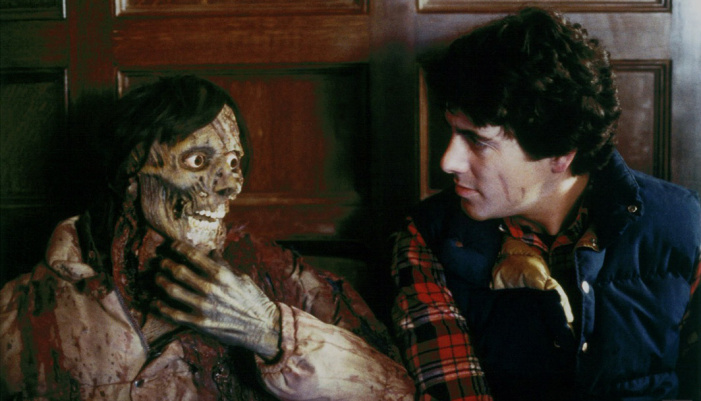
An American Werewolf In London opened in the UK on 12th November 1981 (after its debut at the London Film Festival on 8th November), following its release in the US on 21st August. It was written and directed by John Landis, produced by George Folsey Jr and edited by Malcolm Campbell. Rick Baker (who I wrote an appreciation of here) supervised the special effects make-up, Robert Paynter was the director of photography, Elmer Bernstein provided the music and Deborah Nadoolman (Landis’ wife) was the costume designer.
John Landis came up with the idea whilst working as a production assistant on Kelly’s Heroes in Yugoslavia in 1969. As he and a Yugoslavian crew member were driving to set, they came across a group of gypsies who were performing a ritual, burying the corpse feet first and wrapped in garlic so it couldn’t rise from the grave. The more he thought about it, the more Landis realised he wouldn’t want to confront the undead in real life and wasn’t sure how someone his age - he was 19 at the time - would handle it. “I thought it’d make a great idea for a film,” he said. “I didn't want to do a serial killer or a zombie, I wanted something where you really had to suspend disbelief. I settled on werewolves mainly because, other than ghosts, they're the only really international monsters - every culture has man-beast stories. Even Dracula can turn into a wolf!”
He wrote the first draft in 1969, taking the element of tragedy from the Lon Chaney Jr Wolfman film, “where he himself is the victim” but the script didn’t garner much attention and Landis shelved it. Two years later, he wrote, directed and starred in his debut film Schlock (1973) which introduced him to make-up artist Rick Baker, who also loved the werewolf script. In 1972, Landis met with John Whitney, now regarded as the father of computer animation, to find out if it was “possible for a computer to help the make-up process?” His idea was that Baker would do three or four stages of make-up and the computer would morph them together. Whitney told him it was possible but the technology didn't exist at the time. ILM developed the technique on Willow (1988) and Landis used it extensively in his Black & White music video in 1991.
After hitting it big with The Kentucky Fried Movie (1977), National Lampoon's Animal House (1978) and The Blues Brothers (1980), he was able to secure funding (some $10m) for American Werewolf, though financiers at the time were worried it might be too frightening for a comedy and too funny for a horror film. "The picture was an independent, made as a negative pick-up - a financial arrangement in which a studio/distribution company agrees to purchase an unmade film upon completion - for Polygram in Europe and Universal in the US. We had complete control and it was fun!"
John Landis and Rick Baker
Rick Baker had returned to the project over the years, developing new techniques each time. In the end, it took so long to get financing, he shared the technology with his assistant Rob Bottin as they were about to start work on The Howling (1981). When Landis called to say they had the money, he wasn't best pleased when Baker told him about The Howling but Baker left the project in Bottin's hands to work on American Werewolf.
To facilitate the make-up process, Baker needed the actors six months in advance of shooting and, despite pressure from Universal, Landis resisted the studios initial casting suggestion of Dan Aykroyd and John Belushi. David Naughton got the lead role after an interview, saying “it didn’t hurt that John was an avid Dr Pepper drinker” (the actor appeared in adverts for the drinks brand) and had also cycled across England and studied acting in London. Griffin Dunne hadn’t acted in a film before and got the role after a ten-minute chat with Landis. Naughton believes they got the roles because they were largely unknown and worked well together. “It was the chemistry between myself and Griffin,” he said. Dunne recalls that Landis repeatedly asked if he was claustrophobic without fully explaining why. “I didn’t know what that meant,” he said in interview, “until I ended up in those masks.” British actress Jenny Agutter, who already knew Landis socially, made up the lead trio as nurse Alex Price. “He’s a terrific director, for an actor and brings a huge amount of energy to a film set.”
The beautiful Jenny Agutter, just before the fantastic Moondance sequence
With money and cast in place, Landis set off for London. "I always loved those 1960s films and conceived Werewolf with that spirit in mind. London was horror central, of course, home of Jack the Ripper, Jekyll and Hyde, so I wanted all that Victorian Gothic, but I also wanted to show the real London of 1981." There was also the matter of the Eady Levy, a tax-break agreement that saw a lot of American companies making big films with largely British casts and crews in the 60s and 70s. “When I was shooting Werewolf, Warren Beatty was shooting Reds here and there was also another little film in progress called Raiders Of The Lost Ark," he said. “It turns out mine was one of the last Eady pictures made.”
Like lambs to the slaughter - David Naughton (left) and Griffin Dunne
The Black Mountains in Wales stood in for the moors of Northern England and East Proctor was actually a small village called Crickadam, near Builth Wells in Powys. Working in the cold and wet during the opening scene, Dunne's nose really was running but the laughter between the two actors led Landis to keep the shot in the film
Rik Mayall (left) and Brian Glover (right) in The Slaughtered Lamb
The exterior of The Slaughtered Lamb was a cottage in Crickadam, with the interiors filmed in the Black Swan, in Martyr’s Green, Surrey. The film pub’s regulars consist of a host of British stage and character actors, including Brian Glover (“Beware the moon, lads!”) and David Schofield as the dart player. Rik Mayall is playing chess with Brian Glover and got involved after Jim Henson and Frank Oz took Landis to see The Dangerous Brothers (Mayal and Ade Edmondson) at the Comedy Store though only Rik turned up for filming. Frank Oz (who is in a lot of Landis films) appears twice, as Mr Collins from the American embassy and later as Miss Piggy in a dream sequence.
The first werewolf attack, which sees David get bitten and Jack killed, was filmed at Windsor Great Park near London and was a noisy shoot, with Dunne throwing himself into the part and screaming loudly, even though, he said later, “it was just half a wolf on a wheelbarrow.” The dream sequence, where Naughton runs through the forest, was filmed in Black Park next to Pinewood Studios. He later said the shot of him in the hospital bed was the most uncomfortable sequence to film because of the glass contact lenses.
Dunne found the dead Jack make-up depressing - “I looked like I’d been killed just a few minutes earlier, and it was really unsettling” - and worried how his mother, who’d been ill, would take it. Even so, Landis’ direction for the character - according to Dunne on the DVD commentary - was “no matter what you do, don’t ever sound in anything else but a really good mood.” He wanted Jack to be encouraging, optimistic and cheerful, despite his ongoing deterioration. The version of Jack in the porn theatre was a full-size puppet that Dunne helped operate, controlling the mouth to keep it in sync with his dialogue. That porn theatre was a studio set, a recreation of the Eros Cinema which used to be on the corner of Shaftsbury Avenue and Picadilly Circus.
John Landis and Jenny Agutter shelter from the rain in Trafalger Square
London provided a lot of locations, with filming at Hampstead Heath, Trafalger Square, Well Walk and Haverstock Hill. The hospital was the Princess Beatrice Maternity Hospital in Earl’s Court, which is now a clinic for the homeless and Alex’s flat is on Colherne Road though many of the exterior shots are in Lupus Street, Pimlico (a little in-joke, since ‘Lupus’ is Latin for wolf). The sequence where Gerald Bringsley meets the wolf was filmed during the night at Tottenham Court Road station (and the northbound Northern Line platform), rather than the closed Aldwych station, which is normally used. I remember discovering this on a trip to London in the mid-80s and being thrilled to walk along the same corridors.
London Zoo was used for Naughton’s exit from the wolf cage (captured in one take) and features one of my favourite lines of dialogue - “A naked American man stole my balloons”. The older woman David startles was told he’d appear but not that he’d be naked. Filming ran past the allotted time and paying customers can be seen in the background of some shots.
Landis on set
Landis originally set the climax in Piccadilly Circus because, when he was working in London on the script for The Spy Who Loved Me in the mid-70s, he “went to those little cartoon theatres they had, such as the Eros. So in the original script...there was a Road Runner cartoon playing.” By 1980 all of those cinemas had become porn ones so he changed the script and shot footage for See You Next Wednesday (the first thing to be filmed).
Filming on Piccadilly Circus
Production cars held up non-film road users
Most of the Piccadilly sequence was filmed on location. At the time, Landis said in interview, if you could persuade the local beat bobby to agree to you filming, that was permission granted and he put on a free screening of “The Blues Brothers” at the Empire, Leicester Square, inviting 300 members of the Metropolitan police. He followed that up with a meeting at the GLC, taking models and storyboards to show he had the sequence planned and an endorsement from the Chicago Police Department (with whom he shared a cordial relationship after working on The Blues Brothers) sealed it. The production was given two nights in February to film between 1am and 4am with permission to stop traffic three times (for two minutes on each occasion) and to close a lane. Sections of the Circus were built at Twickenham Studio and the crash scenes were rehearsed extensively until the stunt crew was drilled like an F1 team. Vic Armstrong drove the bus, which had an extra wheel underneath to allow it to skid sideways and the crash could be cleared up and set for another take in minutes. Other crashes on location were filmed with multiple cameras, the resulting destruction cleared up within half an hour. The Twickenham set was used for inserts, such as the bearded man who gets hit by a car and thrown through a plate glass window - played by ex-stuntman Landis himself.
For David’s flashback/nightmare, Rick Baker contributed masks for the Nazi demons though he wanted to do more. “They’re soft rubber and don’t move,” he said later, “but John said that was all he wanted since they were going to be seen in really quick cuts”. Personally, although it’s clear they’re masks, there’s something scary about them because of it and the coda of the sequence, as Nurse Alex opens the curtain in the hospital room, is a real “jump” moment!
Sequences featuring the wolf were shot during production. Landis initially planned to keep its screen time to a minimum, showing it only enough to give an impression of something huge and ferocious (such the long shot where it corners Gerald Bringsley on the escalator) but he liked Baker’s design so much he used it more.
The full transformation sequence was scheduled after principal photography ended (and began the day after the wrap party). David Naughton remembers the first thing Baker said to him when they met in California was “I feel sorry for you” because of the time it would take to make the casts and moulds, let alone the full make-up process. Griffin Dunne (who sounds wonderfully pessimistic) later said “Having that thing dry around your face with those two tubes, it did occur to me that if Rick was a psychotic all he had to do was take out those little straws and watch you suffocate.”
Rick Baker attends to Griffin Dunne's first stage make-up
Bakers key innovation, the Change-O-Heads, were designed for a specific movement that could be repeated (two of them are in the final stages of the transformation, as the snout extends). In interview, he said “we used a fake head. I figured that if we did a piece with the hair punched in and reverse-printed it, it would look like the hair was growing out. And I could push a fake head in weird dimensions, which meant we could shoot parts of the process without any camera trickery. So we made a head, a back, various bits. And we put the guy's body in the set and created a fake body to let the transformation take place on camera.”
Top - how the hand extending was achieved Bottom - the full body puppet (with Naughton supplying the head and arms)
The transformation took six ten-hour days to shoot. Naughton would spend up to ten hours having his make-up applied, be on set for up to five hours, then go through another three hour stint having the make-up removed. Because of the complications (for the full body reveal, only Naughton’s head and arms are seen, the rest is a puppet) there was only time to film one set-up a day and Baker estimates only half an hour of footage was shot during the entire week.
Rick Baker with one of the Change-O-Heads
Each Change-O-Head would take months to make but would be filmed quickly. “We laughed that the head parts took so little time on camera,” said Baker. “It would be, 'Action!' and the thing does its job. “Cut! We got it”, seconds later. I’d be like, “What, is that it? Don’t we need another take?” And John would ask “Does it do anything else?” “Nope.” And that would be it. All that work and it was over in a blink.” He was very pleased later when he took his crew to see the film with a paying audience and when the transformation came on screen, “people stood up, clapped and cheered…”
Aside from Elmer Bernstein’s seven minutes of original score, Landis chose to have an ironically upbeat soundtrack featuring songs that all referenced the moon. Blue Moon by Bobby Vinton runs over the opening credits, Van Morrison accompanies David & Alex making love with Moondance, Bad Moon Rising by Creedence Clearwater Revival plays as David spends the day alone, Sam Cooke sings Blue Moon during the transformation and the same song is covered by The Marcel’s over the end credits. Landis also wanted Bob Dylan’s version of Blue Moon and Moonshadow by Cat Stevens but the requests were denied (Yusef Islam, as Stevens was then known, objected to the subject matter even though Landis pointed out his song is about killing and dismemberment). I have no idea why Warren Zevon’s Werewolves Of London wasn’t included, that would have been great.
Michael Jackson was so taken with the film - especially the make-up effects - that he insisted on hiring the key team for his Thriller (1983) video. When John Landis agreed to direct (it was his first music video), he brought Robert Paynter, Elmer Bernstein, Rick Baker and Deborah Nadoolman with him.
To me, An American Werewolf In London remains a terrific werewolf film, a cracking movie that expertly blends the supernatural with the modern world, humour with horror and monsters with a tender love story. Rick Baker’s special effects are as stunning now as they were 35 years ago and even though they’re shown in bright light, the full werewolf itself still manages to leave something to the imagination. If you’ve never seen it, I envy you the opportunity to do so for the first time and if you have, why not revisit it (as I did last year, on the night of a full moon, at an outdoor showing with my friend David).
Vincent Price and Kim Hunter present Rick Baker with his Oscar
An American Werewolf In London premiered in the UK at the London Film Festival on 8th November 1981 before going on general release on 12th November. Receiving positive reviews from critics, it ended up grossing $61.9m worldwide on a budget of $10m. Rick Baker won the inaugural Outstanding Achievement in Make-up Academy Award, presented to him at the 54th Oscar ceremony by Kim Hunter and Vincent Price. The film was nominated for four Saturn Awards (Best Horror Film, Best Make-up, Best Actress and Best Writing) and won two (Film and Make-up).
The transformation sequence in all its glory (with the key 'Change-o-heads' at 2.01 and 2.09)…
2014 marked the fiftieth anniversary of The Three Investigators being published and, to celebrate, I re-read and compiled my all-time Top 10 (safe in the knowledge that it would be subject to change in years to come, of course). I posted my list here, having previously read all 30 of the original series from 2008 to 2010 (a reading and reviewing odyssey that I blogged here). During 2015 I decided to re-visit some of the books I'd missed on that second read-through, without any intention of posting reviews but, as is often the way, it didn't quite work out like that. I'm happy to say that's continued into 2016 and so here's an additional review...
Collins Hardback First Edition (printed in 1974, never reprinted), cover art by Roger Hall
The Three Investigators crept stealthily through the undergrowth.
Suddenly, somewhere to Bob's left, a branch snapped. Then Bob heard something else - something horribly close. Behind him, almost at his shoulder, there was the sound of breathing.
Bob jumped, twisting in mid-air, to face the being that had come out of the woods. He had an impression of hugeness and matted hair. Then he was staggering, slipping on the earth at the edge of the crevice...
Illustration from the Collins/Armada editions,
by Roger Hall
Following a sudden decision by Aunt Mathilda and Uncle Titus to shut the salvage yard for two weeks and take a holiday, the boys accept an offer to go and stay with Hans & Konrad at their Cousin Anna’s place in Sky Village, Sierra Nevada. She runs the Slalom Inn there and is doing very well for herself, though she hasn’t seen the Bavarian brothers for a while. When they arrive, they discover she’s newly married - to Joe Havemayer - and that she won’t speak German in front of him since he doesn’t understand it. On their first night, a bear gets into the garden but another guest, nature photographer Mr Jensen gets hit in the back of the neck and suspicion seems to fall on the other guest, naturalist Mr Smathers who believes he can communicate with animals. Havemeyer enlists Hans & Konrad to help him build a swimming pool with no shallow end and takes daily visits to the high meadow with a tranquiliser gun and very quickly, Jupiter realises there is something very wrong at the Inn. The third book in the series by M. V. Carey, following the excellent “Mystery Of The Singing Serpent”, this works well in general and has a good pace. Sky Village is well realised (Rocky Beach doesn’t appear at all) with the high meadow and forests particularly atmospheric and the story is populated with a colourful cast of characters, especially Gabby Richardson who runs the local petrol station and doesn’t miss a thing. There’s also a very brief part for Bob’s dad, by phone, who supplies the Investigators with a key bit of information. The story has two strands and the main mystery - why is Cousin Anna very different from how she used to be - is well handled though it does suffer from a denouement that relies heavily on a big coincidence. The secondary mystery, the monster of the mountain (which Gabby originally tells them about), is cleverly used, keeping in the wings - though Bob gets a brief glimpse - until his scene in a key set piece that is well put together. The tone of it, coincidence aside, works smartly and the main mystery is cleverly constructed. Joe and Anna are well realised characters, who arouse suspicion without really seeming to do anything to warrant it whilst Hans & Konrad get to take centre stage, which doesn’t happen often. As well written as we’ve come to expect from M. V. Carey’s work, this has some good set pieces - I liked the crevice sequence, the bear incursion and the fire on the meadow - and I particularly liked the way the monster is used (and the fact that it’s left hanging as to what anybody actually saw). The plot is solid enough, it has a great atmosphere and sense of location and the boys have some nice interplay. A good and entertaining read, I’d very much recommend this.
Format A paperback, first printed in 1977, last reprinted 1980, cover art by Peter Archer There was no format B edition cover scan of my copy
Ah, Halloween, when all the ghosts and ghouls come calling (usually for chocolate), when the evenings are dark and the air smells of woodsmoke and the thoughts of us all turn to the idea of watching something scary and creepy.
Me and Dude as zombies, Halloween 2015
As regular readers of the blog will know, I love behind the scenes stuff for movies (you can check out more on this link) and today, of all days, I thought it'd be fun to show what film crews have to do to make the viewer scared.
When I put the post together I realised that all the films I'd chosen came from the 80s, which isn't to say I couldn't have chosen any other decade (and I'm sure there'll be another post, sometime in the future, doing just that). But I have a special affection for the 80s which might be because it's the decade I came of age - I'll tell you my story about watching Poltergeist in 1983 with friends on a sunny Saturday morning one day - or it might also be because they saw an explosion in horror films with some excellent practical make-up effects. From the master, Rick Baker, to the young turks of KNB, there was some terrific work created to compliment terrific films and I hope you share my love for the ones I've highlighted here.
Happy Halloween!
An American Werewolf In London (1981, directed by John Landis)
special make-up effects supervised by Rick Baker (for which he won an Oscar)
Rick Baker's effects team (with Steve Johnson second left kneeling) sets up one of the transformation shots (the spine popping up). Note that the head is just a wig and the hands/paws are on lengths of wood.
The Howling (1981, directed by Joe Dante)
special make-up effects supervised by Rob Bottin (1981 was a bumper year for werewolf movies! Rick Baker assumed, since it had taken so long to get financing, that John Landis' film wouldn't get made and since he'd already worked out the technology, he shared some of it with his apprentice Rob Bottin for "The Howling". Landis wasn't best pleased...)
Belinda Balaski is attacked by the wolf (Rob Bottin, in white shirt, operates the puppet head and arm)
Scanners (1981, directed by David Cronenberg)
special effects make-up (prosthetics) by Dick Smith, head explosion supervised by Stephen Dupuis
If you've seen the film, you know what this sequence is. If you haven't - and you're squeamish - it's perhaps best not to watch...
Poltergeist (1982, directed by Tobe Hooper)
special effects make-up supervised by Craig Reardon
For the sequence were Marty (Martin Casella) tears his face-off, producer (some also say director) Steven Spielberg was chosen to be the 'hands' of the effect
Videodrome (1983, directed by David Cronenberg)
special make-up effects supervised by Rick Baker
Filming the demise of Barry Convex (the fx crew was under the floor)
Gremlins (1984, directed by Joe Dante)
special effects make-up supervised by Chris Walas
It takes a lot of people to make one Mogwai move...
Nightmare On Elm Street (1984, directed by Wes Craven)
special effects make-up supervised by David B. Miller
for the bathtub scene, Heather Langenkamp was sitting on two planks of wood over a tank. Mechanical Special Effects designer Jim Doyle then sat in front of her wearing the glove - he was chosen to perform the role because he had Scuba experience and needed to be underwater for certain shots
Day Of The Dead (1985, directed by George A. Romero)
special effects make-up supervised by Tom Savini
Seen briefly, but to good effect, in the opening sequence, 'Dr Tongue' is well named. Tom Savini is operating the arms of the puppet and the man with the creepshow t-shirt is Greg Nicotero, who would go on to co-found KNB Efx and is now one of the leading lights in The Walking Dead crew.
Fright Night (1985, directed by Tom Holland)
special make-up effects supervised by Steve Johnson
The meltdown of Billy Cole
The Fly (1986, directed by David Cronenberg)
special make-up effects by Chris Walas
Brundlefly starts to walk...
Robocop (1987, directed by Paul Verhoeven)
special make-up effects supervised by Rob Bottin
Officer Murphy is shot to pieces by Clarence Boddicker and his gang
Evil Dead 2 (1987, directed by Sam Raimi)
special make-up effects supervised by Mark Shostrom
Greg Nicotero (he got around) operates the Henrietta head to terrorise Ash (Bruce Campbell)
Child's Play (1988, directed by Tom Holland)
special make-up effects supervised by Kevin Yagher
It took a lot of wires to make Chucky move... Howard Berger, holding the puppet and not looking too happy about it, co-founded KNB Efx and won an Oscar for his work on The Chronicles of Narnia: The Lion, the Witch and the Wardrobe.
Phantasm II (1988, directed by Don Coscarelli)
special make-up effects supervised by Mark Shostrom
The Tall Man puppet stands in for Angus Scrimm as things get sticky towards the end. At the back of the picture, with the beard, is Robert Kurtzman, who would go on to co-found KNB Efx (he has since left)
Look out for more make-up and behind the scenes posts to come...
Last Thursday saw the official paperback launch of The Christmas Promise, the latest novel by my fine friend and critiquing buddy Sue Moorcroft. The ebook was released on the 6th but, since Sue was in Nottingham to run a writing course, her publisher - Avon Books - arranged for Waterstones to have the first of the paperback stock.
I’m a big fan of Sue’s writing (you can read my latest interview with her here) and was happy to help her celebrate the launch of this novel, the first in a two-book deal with Avon that will hopefully see her become much more successful.
Sue with the book (Ava is a miliner, which is why Sue's wearing a specially made fascinator)
I caught the train up (and used the travel time to get into C. L. Taylor’s The Lie, which is excellent), had a wander around the centre and grabbed a quick bite to eat before heading to Waterstones on Bridlesmith Gate. It’s a huge shop and I had a good look around as I worked my way up the stairs (no escalators for me!) to the Events Room on the fifth floor (admiring the rooftop vistas of the city on the way).
Nottingham rooftops
With Mick Arnold (picture by John Jackson)
I arrived at 5.45 and there were already plenty of people milling around. I said hello to Christina Courtney, who I first met at the Writer/Blogger meet-up in London (see here) and finally met fellow Team Sue Moorcroft member John Jackson in person. I then saw Mick Arnold, who I first met at the Brum Writer/Blogger meet-up (see here) who also supported (and photographed) mine and Sue’s KettFest talk (which you can read about here). We chatted for a while then mingled and I finally got to meet Lizzie Lamb, having been Facebook friends for some time.
With Lizzie Lamb (picture by June Kearns)
The events room (picture by John Jackson)
We were told to take to our seats so I went to sit on the front row with Mick and he introduced me to Morton Gray and Alison May, both fellow novelists (Alison & I thought we’d met before and, after a while, realised we had, in Birmingham). Just before it began, Wayne Parkin (my friend and Con buddy) arrived from work for a fleeting visit and it was good to see him again (FantasyCon feels so long ago).
The launch kicked off at 6.15 and, after Dan the Events manager did his little intro, Sue read a brief passage from the book, featuring Ava (the heroine) and Sam (the hero). It’s been a while since I read it (I critiqued it back in 2015 - it’s very odd reading a Christmas novel out of season) but listening to Sue made me want to revisit it. Dan interviewed Sue briefly (the revenge porn aspect of her plot has seen an article she wrote appear on The Huffington Post, before being picked up by The Independent) and then it was thrown open to the floor. There were several questions (I asked one too) which elicited some great answers, then it was time for photographs and picking up advance copies. I stood chatting with Wayne and Andrea Crellin (Sue’s friend, who I met at the KettFest event) and by the time I’d got to the book table, they’d all gone (a superb result for Sue, not so good for me!).
Wayne Park & I pose with his copies
After chatting with various folk for a while, Mick & I headed back to the train station and talked writing and reading for the entire journey home.
All in all, it was a great evening for a great writer (and friend) and I hope The Christmas Promise is hugely successful for her.
The fifth, in an occasional thread, of blog posts celebrating those cheesy, sleazy old-school pulp paperbacks from the 70s and 80s, which are now mostly forgotten. Yes, we’re not talking great art here but these books have their place - for better or worse - in the genre and I think they deserve to be remembered.
This time around, I'm looking at a novel with a bit of pedigree, though I would take exception to the cover comparisons...
cover scan of my copy - published in 1983 by Sphere
Galen is an ordinary, peaceful small town. Until horrendous terror strikes … and strikes again and again, each time claiming a female victim in a fashion too hideous to contemplate.
Julian Trask, student of the occult, is used to thinking the unthinkable. As he works towards the solution of the soul-searing mystery, Galen trembles in mortal dread. For no woman is safe from the lethal lust of THE INCUBUS.
This is unashamedly pulp and all the more fun for it. Ray Russell is a genre writer with a great pedigree (amongst many other things, he wrote the screenplay for X: The Man With the X-Ray Eyes) and this novel (first published in 1976) works a treat so long as you enjoy it for what it is, a quick and cheesy novel (though curiously coy when dealing with sex, which is ironic considering the subject matter).
Characterisation is brisk - Julian Trask, English, handsome and Porsche driving, is drawn back to the town where he once taught briefly; Laura Kincaid was a student he fancied back then, now she edits the paper he subscribes to, which is where he found out about the killings; Dr ‘Doc’ Jenkins is the town physician (I couldn’t tell how old he was supposed to be) who’s well respected and good at his job, even if his alcohol intake is prodigious (and he & Trask make for a fun double-act) and Hank Walden is the town Sheriff, a man at his wits end trying to figure out what’s going on. There’s a big supporting cast too, with plenty of “it could be him” characters and the attack set pieces are well enough constructed that it could be anyone who turns into the monster - and what a monster the Incubus is, never really seen clearly but identifiable from his extremely large penis (which is what kills his victims - he wants to mate and rapes them to death).
With a decent small-town atmosphere, a great MacGuffin (The Artes Perditae spell book, covered in human skin so that the “i” is dotted by a navel), some great set pieces (though the section in the dormitories could have been better realised I think and the writer missed a big chance for a stalking sequence) and nicely used gore (making up for the coy sexual references), this does exactly as it’s supposed to. As ever, your enjoyment will depend on your tolerance for (relatively well constructed) pulp, but I enjoyed it a lot and would recommend it for fans of the same.
* * *
Incubus one-sheet, art by Drew Struzan
The Incubus (1982) was directed by John Hough (who had a varied career, including making Dirty Mary, Crazy Larry which, for a long time, I only knew through the opening credits of The Fall Guy), produced by Marc Boyman ('presented by' Stephen J. Friedman, whose solid career started with The Last Picture Show) and written by George Franklin (who only has one other credit to his name according to the imdb, a 1990 telemovie called Personals).
The film was made in Canada on a budget of $5.1m, released by Multicom Entertainment Group Inc. and starred John Cassavetes as Sam (perhaps Julian was too English?), John Ireland as Hank and Kerrie Keane as Laura. It was never released theatrically in the UK (to this day, I’ve never seen it) but features a cameo from Bruce Dickinson (of Iron Maiden fame) performing with his previous band Samson.
As an aside, I like how the film poster goes in a different direction to the tone the book cover aims for (though the Drew Struzan artwork is typically wonderful).
I don't think that's really HD, do you?
As for the VHS version, they just had a field day with the artwork. I can only assume it was never in a video shop during my teens because I would have snapped this up in moments!
* * *
Ray Russell was born in Chicago on 4th September 1924 and served in the South Pacific as part of the US Air Force from 1943 to 1946. He married Ada Szczepanski in 1950, they had a son and daughter and he died in Los Angeles on 15th March 1999.
Ray Russell
A peer and close friend of Richard Matheson, he was a prolific short-story writer and an occasional novelist, though his preferred length was the novella. He recognised the cultural significance of genre fiction and his best-known work, Sardonicus, was a novella that Stephen King called ‘perhaps the finest example of modern gothic ever written’. It originally appeared in the January 1961 issue of Playboy and Russell subsequently adapted it into a screenplay for the William Castle film, which was called Mr Sardonicus (1961).
An executive editor for Playboy during its formative years in the 1950s, Russell kept a strong link with the company through to the 1970s, editing (anonymously) many of the magazines anthologies, including The Playboy Book of Science Fiction and Fantasy (1966) and The Playboy Book of Horror and the Supernatural (1967). Through him, Playboy became a showcase for genre fiction (principally SF and horror) during the 1950s and 1960s, publishing stories by Ray Bradbury, Henry Slesar, Frederic Brown, Kurt Vonnegut, Frederik Pohl, Richard Matheson, Jack Finney, Robert Bloch and Charles Beaumont (with whom Russell co-wrote the screenplay for The Premature Burial in 1962).
His other screenplays were for Zotz! (1962), The Horror of It All (1963), X: The Man with the X-Ray Eyes (1963) and Chamber Of Horrors (1966). The superb “X”, which features a manic Ray Milland and one of the best last lines in cinema, won Russell (and his co-screenwriter Robert Dillon) a Silver Globe at the Trieste International Film Festival in 1963.
In 1991 he received the World Fantasy Award for Lifetime Achievement.
When asked why he wrote, he is quoted as saying; “I would say ... ego, guilt, boredom, the need for approval, a love of language, and the desire to entertain myself. I think it was William Saroyan who said he wrote so that he would have something good to read in his old age. That's not a bad reason.”
For a few years now, I've been collecting old 70s and 80s paperbacks (mostly horror), picking them up cheaply in secondhand bookshops and at car boot sales and slowly building a collection. My friend (and fellow collector) Johnny Mains once told me that charity shops sometimes pulp old books like this because the market for them is so small - I understand why but I think it's terrible. We might not be talking great art here but on the whole, I think these books deserve to be remembered.
To that end, on an irregular basis (too much cheese isn't good for anyone's diet), I'm going to review these "old-school" horrors (and perhaps include some bonus material, if I can find it).


 Aside from Elmer Bernstein’s seven minutes of original score, Landis chose to have an ironically upbeat soundtrack featuring songs that all referenced the moon. Blue Moon by Bobby Vinton runs over the opening credits, Van Morrison accompanies David & Alex making love with Moondance, Bad Moon Rising by Creedence Clearwater Revival plays as David spends the day alone, Sam Cooke sings Blue Moon during the transformation and the same song is covered by The Marcel’s over the end credits. Landis also wanted Bob Dylan’s version of Blue Moon and Moonshadow by Cat Stevens but the requests were denied (Yusef Islam, as Stevens was then known, objected to the subject matter even though Landis pointed out his song is about killing and dismemberment). I have no idea why Warren Zevon’s Werewolves Of London wasn’t included, that would have been great.