Monday, 31 January 2022

The Mystery Of The Laughing Shadow, by William Arden

2014 marked the fiftieth anniversary of The Three Investigators being published and, to celebrate, I re-read and compiled my all-time Top 10 (safe in the knowledge that it would be subject to change in years to come, of course).  I posted my list here, having previously read all 30 of the original series from 2008 to 2010 (a reading and reviewing odyssey that I blogged here).

Following this, I decided to re-visit some of the books I'd missed on that second read-through, without any intention of posting reviews of them but, as if often the way, it didn't quite work out like that.  Happily, this is on-going and so here's an additional review...
Collins Hardback First Edition (printed in 1970 and never reprinted), cover art by Roger Hall
Slowly the massive gate swung open on creaking hinges.  The boys froze.  Suddenly, as if from nowhere, a grotesque, humpbacked shadow towered over them, its head jerking wildly.  Then an evil laugh shattered the night…

A tiny Mexican statue and an ancient message written in blood put The Three Investigators on the track of the priceless Chumash treasure hoard, lost in the mountains for two hundred years.  In a desperate race against time, Jupe, Pete and Bob battle to find the jewels…

illustration from the Collins Hardback edition (there
are no illustrations in the paperbacks).
Jupe & Bob hide from the Yaquali Indians at the
Vegetarian Society House, the sequence right before
the one shown on the format a paperback cover.
Bob Andrews and Pete Crenshaw are on their way home from a day spent in the mountains and, as they pass the old Sandow Estate, hear someone call for help.  After investigating, they find a small gold statuette then see “a tall, twisted, humpbacked shadow with a beaky nose and small jerky head.  It utters a wild, shattering laugh.”  Terrified, they race back to Rocky Beach but when they tell Jupe the next day, they realise neither of them heard exactly the same thing.  When a young Englishman, Ted Sandow, calls at the Junkyard offering Uncle Titus to rummage through some old barns, it seems as though the boys were seen and some people are very keen to get their hands on the statuette - or what was inside it.

The first official entry in the series by William Arden (the pen-name of prolific mystery writer Dennis Lynds) even though he'd already written the excellent The Mystery Of The Moaning Cave (credited to Robert Arthur), this proved the boys were in safe hands, with his assured style working just as well here.

The central concept - the laughing shadow - is a good gimmick but little more than that, similar to how The Mystery Of The Flaming Footprints captures the imagination but doesn’t really sell the story.  This features kidnapped Yaquali Indians, suspicious Englishmen and the long-lost treasure of Magnus Verde, the Chumash Hoard and is great fun.  Arden sets up some decent set pieces and gives the lads different things to do, allowing them to show their strengths all the way through the piece.  As with Moaning Cave, Arden makes great use of the Californian mountains, with plenty of action taking places on hills and in box canyons, creating a wonderful sense of bleakness to them.

Alfred Hitchcock has a decent part to play - setting the boys on the path to finding out about the Chumash Hoard - as do Aunt Matilda and Uncle Titus.  Worthington makes a welcome return and it’s always nice to see Mr Andrews (we even get a cameo from a sleepy Mrs Andrews).  As well written as you'd expect, with some gripping action sequences, this also has a nice line in humour.  One of the key supporting characters, Mr Harris, runs the Rocky Beach Vegetarian Society who operate from a fantastic Gothic house on Las Palmas Street ('It was the last house on the block, located right on the edge of town. The dry brown mountains came straight down to the road on the other side.').  After an incident there, Jupe asks, “Could one one of your assistants have told them?”  “No,” Harris tells him, “they’re old friends and staunch vegetarians.”

Good fun, told with wit and pace, this is very much recommended.
Armada format a paperback (printed between 1973 and 1980), cover art by Peter Archer
(cover scan of my copy)
Armada format b paperback (printed between 1982 and 1984), cover art by Peter Archer
(cover scan of my copy)

The internal illustrations for the UK edition were drawn by Roger Hall, though they only appeared in the hardback edition for some reason.

Thanks to Ian Regan for the artwork (you can see more at his excellent Cover Art database here)

Monday, 10 January 2022

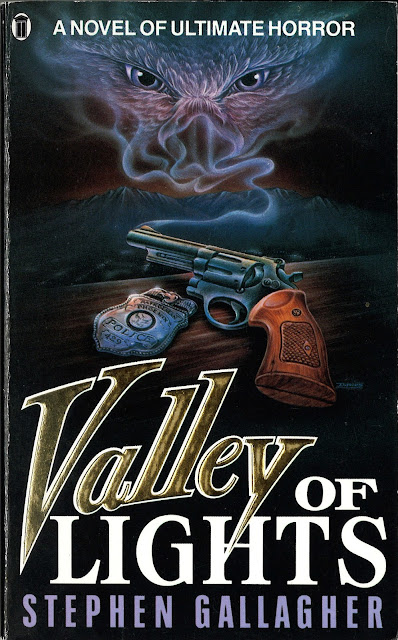
Valley Of Lights, by Stephen Gallagher (a review)

In a new edition of the occasional series, I want to tell you about a book I've just read and loved, which I think adds to the horror genre and that I think you'll enjoy if you're a fan.  In this case, however, it's a book that first came out in 1987 (yikes, 35 years ago!), so chances are you might have already heard of it.  I discovered it, quite by accident, in the fantastic LOROS bookshop on Queens Road in Leicester, when I was in town a couple of years back (for my 50th) with The Crusty Exterior (as I wrote about here).  Last year, my friend Mark Morris posted about the novel on Facebook and I decided to give it a try and I'm really pleased I did.
cover scan of my copy, the 1988 NEL 2nd impression
Imagine the heartbeat of a murderer - and that it's someone you know.  You kill him.

But he returns in another body.

And when that body lies cold in the morgue...

...he's still out there somewhere.

No matter what you do, he comes back again and again.

Because he will never die - and he doesn't have a name.

Imagine - and shudder.


In Phoenix, the brain-dead are rising from their hospital beds and when local children are found, brutally murdered, Sergeant Alex Volchak of the Phoenix Police makes the connection but it’s so fantastic, nobody in the department will listen to him.

First published in 1987, this is a winning combination of crime and horror, perhaps the perfect companion piece to the equally assured Falling Angel.  Alex Volchak is a great protagonist, world weary, lonely and bereaved, keen to see justice done but happy to bend the rules when it suits the common good and he’s blessed with an amusingly deadpan film noir style voice.  His tentative relationship with Loretta, his neighbour in the trailer park where they live, is beautifully observed but rather than her be the stereotypical “single mum whose child needs a father figure”, she’s gutsy, independent and amusing, a force of nature who drives some of the plot later on and whose child, Georgie, sets off the last act.  The villain is a supernatural entity and here is the only place time hasn’t been kind to the novel - back in the late 80s, this may have been a more unique angle but, like the antagonist in Falling Angel, it’s been ripped off so many times it does perhaps lose some of its force for people who weren’t there to witness it the first time around.  Having said that, Gallagher has a lot of fun with the malevolent being and some of his ‘disguises’ (it’s an old novel, yes, but I don’t want to spoil it completely) are cleverly utilised.  Once Alex makes the connection between the killings and the brain-dead bodies they keep finding around the city, he tries to explain it to his bosses - who, obviously, don’t believe him - and then it’s down to him to try and stop the supernatural killer.  There’s a beautiful simplicity and logic to this, as the two characters come together, one a contemporary cop who’s struggling to make sense of everything, the other an ageless monster who normally manages to move amongst the living without drawing too much attention to himself.  

Gallagher uses Phoenix well, a dusty desert town with plenty of dark alleys and dodgy motels and sets a lot of his horror in bright sunlight, adding an almost banal atmosphere to the darker happenings, which only serves to make them even more powerful.  

With a strong supporting cast, a great pace and voice, this is well worth a read and I would highly recommend it.

***
Valley Of Lights might not the best known of Gallagher’s work these days (people are more likely to know the likes of Oktober and Chimera, as well as his numerous screenplay credits) but it was the first to bring attention to his name.  At the time he wrote it, he was “in the really low point of [his] career”, as he’d just shelved the novels The Boat House and Oktober “because nobody wanted to touch [them]”.  Happily, once Valley Of Lights sold, Oktober sold afterwards and The Boat House has also appeared.

There were plans for Valley Of Lights to be made into a film, as he told Paul Tomlinson in an interview that first appeared in the fanzine Other Times.  When Gallagher wrote the novel, he had an ongoing relationship with a director and they were looking for a film to make together.  He handed over some pages of the novel and the director showed them around in the USA and got some interest.  A producer took out an option and Gallagher wrote a screenplay but they couldn’t generate enough interest (“now the truth of this situation is that everybody in Hollywood, and everybody in the film business, is looking for reasons to turn things down. Because turning something down is the safest bet.”).  By the time of his tenth re-write of the script, he realised “rewriting on the basis of rejection was wearing the script down, just destroying it.  It wasn’t my Valley of Lights story any more.”  After two years, when asked for another re-write, he’d finally had enough and “I honestly can’t repeat what I gave as my answer.”

When the rights went to a British company called Zenith in 1990, they put together a new version of the script which Gallagher liked a lot “because it was my story again” - everything he’d had to include in re-writes to try and get a sale had been taken out.  The interview is undated but as Zenith ceased trading in 2006, I have to assume we’ll never get to see the film of this excellent novel.

Stephen Gallagher, born on 13th October 1954, is a novelist, screenwriter and director specialising in contemporary suspense (according to his website).  I had the great fortune to meet him briefly, after he spoke on a panel about screenwriting at Peterborough FantasyCon and he came across as a genuinely lovely man.


Tuesday, 21 December 2021

The Thirteenth Annual Westies - review of the year 2021

Well, after another odd year, here we are again, gearing up for Christmas and so it's time to indulge in the annual blog custom and remember the good books of 2021.

Once again, it's been a great reading year for me (in fact, I've read more books this year than I have since I began my spreadsheet in 2002) with a nice mixture of brand new novels, a few books that have languished on my TBR pile for too long, some good second-hand finds (which jumped straight to the top of the pile) along with some welcome re-reads.

As always, the top 20 places were hard fought and, I think, show a nice variety in genre and tone - if I've blogged about a book before, I've linked to it on the list.

Without further ado, I present the Thirteenth Annual Westies Award - “My Best Fiction Reads Of The Year” - and the top 20 looks like this:


2:   Season Of Mist, by Paul Finch
3:   Valley Of Lights, by Stephen Gallagher
4:   The Saturday Night Ghost Club, by Craig Davidson
6:   Summer At The French Park Café, by Sue Moorcroft *
7:   Clown In A Cornfield, by Adam Cesare
8:   Of Men And Monsters, by Tom Deady
9:   Don't Turn Around, by Jessica Barry
10: Blow Out, by Neal Williams
11: Reckless, by R J McBrien
13: The Flight, by Julie Clark
14: Driftnet, by Lin Anderson
15: The Other Passenger, by Louise Candlish
16: Murder Most Unladylike, by Robin Stevens
18: Later, by Stephen King
20: The Cottingley Cuckoo, by AJ Elwood

* This will be published in the summer of 2022, I read it to critique


The Top 10 in non-fiction are:

1=: Days & Ages, by Mark Beaumont
3:  The Storyteller, by Dave Grohl
4:  The Bassoon King, by Rainn Wilson
5:  Paperbacks From Hell, by Grady Hendrix
6:  Lonely Boy, by Steve Jones
7:  In The Pleasure Groove, by John Taylor
8:  A Long Time Ago in a Cutting Room Far, Far Away, by Paul Hirsch
9:  Imperfect Hero: Harrison Ford, by Garry Jenkins
10: Star Wars Year By Year, by Lucy Dowling


Stats wise, I’ve read 91 books - 42 fiction, 21 non-fiction, 16 comics/nostalgia/kids and 12 Three Investigator mysteries.

Of the 79 books, the breakdown is thus:

7 biography
20 horror
14 film-related
6 drama (includes romance)
16 crime/mystery
5 sci-fi
2 nostalgia
9 humour

All of my reviews are posted up at Goodreads here

In case you’re interested, the previous awards are linked to from here:

Monday, 13 December 2021

Nostalgic For My Childhood - Christmas Annuals (part 5)

"Christmas is coming!"
Me, Christmas 1975 - Action Man helicopter, Batman, Six Million Dollar Man, Planet Of The Apes annual and a gun that shot darts with rubber tips!  Seriously, how much more excited could a 6-year-old kid look?
Welcome to the fifth post (you can find the others on these links, for 20172018, 2019 and 2020) showcasing one of the Christmas highlights from when I was a kid (beyond the catalogues I wrote about in 2016), seeing which annual I got that particular year.  If you don't remember them, annuals were (and still are) large size hardback books, designed for children and based on existing properties, generally comics and popular TV shows, as well as the occasional film and sport and pop round-ups.

The ones based on comics featured the same cast as the weekly editions, while the TV and film ones had comic strips, the occasional short story, fact files and interviews and - brilliantly - in the case of The Fall Guy, behind the scenes information on stunts and how they were filmed.

Generally published towards the end of the year, annuals are cover-dated as the following year to ensure shops don't take them off the shelves immediately after the new year (though, by then, unsold copies are often heavily reduced).  Still as popular now, the only difference (apart from the fact kids today don't have the choice of comics we did) seems to be that they're skinnier (and that's not just me being all nostalgically misty about it - my ones from the late 70s and early 80s are substantially chunkier than the ones I bought for Dude when he was younger - he's 16 now and annuals don't feature on his wish list).

Here, then, is another selection of old favourites, ones I received and ones I remember my sister Tracy having.  I hope some of them inspire a warm, nostalgic trip down memory lane for you...

1976
It's often said you were either a "Blue Peter kid" or a "Magpie kid" but I used to alternate between the two.  Which did you prefer?
1977
I started watching this because of Captain Scarlet and didn't remember a great deal about it, to be honest, until I caught up with it on ForcesTV.  It hasn't aged well, it must be said, though the model work is superb.
1978
1978
 Rupert The Bear makes his statutory appearance...
1978
1979
1979
I was a big fan of The Professionals and still am, the shows holding up remarkably well (as do the novelisations, which I wrote about here).
1979
The Six Million Dollar Man led me to the Bionic Woman, which I watched and enjoyed.  I don't think I've ever seen Max The Bionic Dog though (I wonder if he got his own annual...).
1979
1980
Probably the line-up I remember the most.
1980
1980
The series had long finished by the time this was published and I didn't realise it existed until I started researching these blog posts.  How could I have missed this, from my childhood hero (who I wrote about here)?
1981
1981
1981
Spun off from the TV show (which I remember finding extremely funny), I wonder how much of the humour went sailing over my head?


Happy Christmas!


scans from my collection, aside from the girls titles (thanks to the Internet for those)

You can read more of my nostalgia posts here

Monday, 29 November 2021

Visions Of Ruin, a horror novella

After it was revealed in the latest NewCon Press newsletter, I'm proud to announce that they will be publishing my horror novella, Visions Of Ruin, early in 2022.
Me, on a Surrey bike, just outside Holimarine Corton, summer 1986
Having spent the last four years writing three mainstream thriller novels (which are now going to be published by The Book Folks, as I wrote about here), I've only dipped a toe back into horror when people have asked for short stories.  But the genre is in my blood and when Ian Whates asked if I'd like to write a novella for him, I jumped at the chance - I like and respect him a lot and I'm proud to be associated with NewCon Press.

Ian writes in the newsletter:
"I am delighted to welcome Mark West back to NewCon Press' publishing schedule. Mark's short fiction has appeared in several of our anthologies over the years, including Ten Tall Tales and Hauntings, but this time he contributes a longer piece, Visions of Ruin, which will be the 8th entry in our NP Novella series. I rate this as Mark's most accomplished work to date, and was bowled over by it on first reading."

I began work on the novella whilst my latest thriller - Jenny Was A Friend Of Mine - was out on submission and it was a real delight to go back to horror, working in the novella format which I think suits the genre so well.  The idea took a little while to come together but once I realised it was set in the 80s, featuring teenagers in a rainy seaside town, I was off and running, the writing process itself (which involved me drawing several maps of the caravan park central to the story) being hugely enjoyable.


Ian, from the newsletter:
"A week in a caravan at 'The Good Times Holiday Park' at the edge of a rundown seaside town is not exactly the holiday sixteen-year-old Sam has been dreaming of, but he knows his mum is struggling and doing the best she can. At least he meets someone his own age to hang out with – Polly – but neither of them are prepared for the strangeness that ensues. Full of deft touches that bring the 1980s setting to life and populated with a cast of fully rounded characters that the reader can immediately relate to, Visions of Ruin will be released in early 2022."

I will post more details when I'm able, but I have to say, I'm looking forward to seeing Sam and Polly ride their Surrey bike out into the world.


Thanks to Ian for both asking for and then enjoying the story enough to want to publish it, Nick Duncan for taking the picture all those years ago and for our adventures on the east coast in the 80s, Teika Marija Smits who helped push me to start and, as always, David Roberts for the Friday Night Walks and the mammoth plotting sessions.

Monday, 15 November 2021

The Mystery Of The Shrinking House, by William Arden

2014 marked the fiftieth anniversary of The Three Investigators being published and, to celebrate, I re-read and compiled my all-time Top 10 (safe in the knowledge that it would be subject to change in years to come, of course).  I posted my list here, having previously read all 30 of the original series from 2008 to 2010 (a reading and reviewing odyssey that I blogged here).

Following this, I decided to re-visit some of the books I'd missed on that second read-through, without any intention of posting reviews of them but, as if often the way, it didn't quite work out like that.  Happily, this is on-going and so here's an additional review...
Collins Hardback First Edition (printed in 1973 and never reprinted), cover art by Roger Hall
The Three Investigators followed the winding path.  All at once, a loud chilling scream echoed through the jungle vegetation.  It sounded again - directly in front of them!

Jupiter parted some thick leaves.  In a small clearing crouched a huge spotted cat.

“A leopard!” Jupiter said.  “Run!”

A voice spoke sharply from behind them.

“So!  I’ve caught you.  Don’t try to get away.”

They whirled to see a big, bear-like man.  In his hand was a gleaming spear…

The boys are on a buying trip with Uncle Titus, visiting the home of Professor Carswell and his son Hal, who are looking to sell the few belongings of their recently deceased tenant, Joshua Cameron, who died owing them money.  Cameron was an artist and among his possessions are twenty paintings, all showing his cottage, though it changes size in each one (looked at in order, the cottage appears to shrink, hence the title).  Jupiter thinks he spots someone and the boys end up chasing the intruder through the canyon, though he escapes in a car.  After Uncle Titus has managed to sell all of Cameron’s goods (including the paintings), the boys are contacted by the Countess and her estate manager, Armand Marchal.  It seems she is Cameron’s much younger sister, though they’ve been estranged for a while and she’s keen to have something to remember her brother by.  On the trail of the missing paintings which may - or may not - lead to riches, the boys encounter DeGroot, a mysterious Dutch art dealer and have run ins with Skinny Norris, with more villains popping up as the hunt intensifies.

The fourth book in the series by William Arden (the pen name of thriller writer Dennis Lynds) after a break of two years (he wrote The Mystery Of The Moaning Cave (1968) whilst creator Robert Arthur was still alive, then continued the series with The Mystery Of The Laughing Shadow (1969) and The Secret Of The Crooked Cat (1970)), this is as tightly plotted and well paced as all his books.  Arden makes good use of the canyon and gully around the Carswell property, while Cameron’s cottage is cracking location for some nicely done ‘in peril’ sequences.  There’s also a cleverly constructed ‘locked room’ mystery mid-way through at the studio of artist Maxwell James (who supplies the leopard seen on the paperback art).  Headquarters is used sparingly although, following an uncharacteristic slip by Jupiter, the Junkyard hosts an amusing scene where it’s over-run with local kids trying to help as part of the Ghost-to-Ghost hook-up.

The central mystery - the story behind the paintings and how they might lead to treasure - is well handled, if occasionally dry but having said that, the logic of it works perfectly and it plays out nicely, with Jupe putting the clues together well (and Hitchcock matching him in the deductions later).  The boys all have a clear role to play, the supporting characters are well-rounded and serve a purpose and it’s always fun to have Uncle Titus involved.  The Hitchcock intro is odd though, with the master director suddenly having an attitude similar to the one he had on The Secret Of Terror Castle.

As well written as we’ve come to expect from William Arden, this has some smart set pieces and also what I hope are some nice little in-jokes.  I really want Professor Carswell to be a nod to Night Of The Demon while one of Cameron’s bric-a-brac items was sold to a Mrs Leary who lives on Rojas Street (Rojas was the main villain from The Mystery Of The Silver Spider).  A solid plot, a great sense of location and some nice interplay with the boys, this is an entertaining read that I’d very much recommend.
Armada format a paperback (printed between 1976 and 1979), cover art by Peter Archer
(cover scan of my copy)
Armada format b paperback (printed between 1981 and 1983), cover art by Peter Archer
(cover scan of my copy)

There were no internal illustrations for the UK edition, more's the pity - the US had some and I'd like to have seen Roger Hall's take on them.

Thanks to Ian Regan for the artwork (you can see more at his excellent Cover Art database here)
Monday, 1 November 2021

Under The Mistletoe, by Sue Moorcroft

Regular blog readers will know I've been friends with Sue Moorcroft for a while, having met at the Kettering Writers Group in 1999 (the group leader was of a more literary bent, so we genre writers were consigned to the back of the room, where we had great fun).  Since then she's gone from strength to strength, hitting number one in the Kindle Bestseller charts (with The Christmas Promise), becoming a Sunday Times Best Seller and her novel, A Summer To Remember (which I wrote about here) won the Goldsboro Books Contemporary Romantic Novel Award 2020.  As well as featuring her a lot on blog (to see more, click this link), I'm also pleased to be one of her beta-readers and thoroughly enjoyed her latest novel, Under The Mistletoe, now available in paperback and as an e-book.

Snuggle up with a mince pie, a cup of cocoa and the most heartwarming book this Christmas from the bestselling Sue Moorcroft.

Christmas. A time for family, friends – and rekindling old flames…

When Laurel returns to the village of Middledip, she’s looking for a quiet life. Adjusting to her recent divorce, she’s ready to spend some time getting back on her feet amidst the glorious snow-dusted countryside.

Yet, life in Middledip is far from straightforward. Coming to the aid of her sister, Rea, as she navigates her own troubles, Laurel barely has a moment to think about where her own life is going.

However, time stands still when she sees her old flame, Grady Cassidy – and it’s soon as if they’ve never been apart. But through her happiness, Laurel remembers why she left the village all those years ago, as she recalls a dark night and Grady’s once-wayward brother, Mac…

Can Laurel learn to forgive and forget? Or will her chances of Christmas under the mistletoe with Grady remain a dream?

My review:
Another winner, this is set in the heart of Sue's beloved Middledip and all the better for it.  Laurel, orphaned as a teen and looked after by her older sister Rea, left Middledip after a sexual assault and only comes back as a thirtysomething to help Rea with her daughter Daisy.  While there, she literally bumps into one of the group who attacked her, along with his brother Grady, who Laurel fancied at the time and still, she discovers, has a thing for.  Now a successful artist, Laurel is soon drawn into village life and as her relationship with Grady builds, so does the inevitable confrontation with the people who caused her so much anguish.  Strikingly well told, as always, this is filled with vivid characters (a lot of whom have either been the protagonists of previous novels, or were at least featured players), plenty of humour and a willingness to deal with the grittier side of life.  Hugely entertaining, thoroughly embracing the spirit of Christmas (I defy anyone to read this and not see the little cottages swathed in snow) and told with wit and pace, this is a cracking novel and I highly recommend it.
* * *

Thankfully - taking care to mask up and socially distance - Sue & I have been able to start meeting again, to chat over a drink at The Trading Post and I took the chance to ask her a few questions about the new novel.

MW:   Thanks for doing this Sue and I have to say, the book is a real treat.  What was it that sparked it off in the first place?

SM:   I had a memory of something that I think happened locally when I was at senior school, which caused a bit of a stir. I remember hearing a man say, dismissively, ‘Surely it was just horseplay that got out of hand?’ and I wasn’t impressed with his attitude. I haven’t given the exact same situation to Laurel but one that has much in common with it. Then I sat back and tried to work out the attitudes of various characters. It soon became clear that forgiveness - or being unable to forgive - was going to be a major theme.

MW:   I really enjoyed your setting for the book and I'm sure your fans will too but for you, as the writer, how much fun was it being back in Middledip for Christmas?

SM:   A lot. Middledip certainly knows how to do Christmas! The pub’s lit up like Santa’s Grotto and there are Christmas trees in every window. I enjoyed creating a village art group and have them all make Christmassy things. The cover image is actually a slice of a picture painted as a community art project.

MW:   There's a testing of sibling love in the story, did that come from personal experience?

SM:   Not at all. I’m very lucky that I get on extremely well with my brothers. I think that’s why I went onto Twitter and asked people how they’d feel if their sibling had been involved in ‘horse play that got out of hand’, especially if they loved them and looked up to them. Interestingly, not a single person said they’d overlook it. They spoke of disappointment and disillusionment. They felt that when trust was broken at such a fundamental level it would be hard to deal with, despite them continuing to love the person in question. I don’t think I could have had Grady and Mac stop speaking or anything, though.

MW:   I remember reading some of the online responses and have to say, I felt the same way.  Moving on a big element of the novel is accepting people's faults and issues and forgiving them.  Where did that come from?

SM:   When Grady learned the truth about what Mac got caught up in led me to puzzle over how Laurel was going to be able to move forward with a life with Grady. Her - very understandable - feelings had painted her into a corner. In fact, she’s plagued by a desire for revenge, rather than a wish to let bygones by bygones.

Mac was in a bad situation, too. He was horrified when Laurel returned to the village. To him, her reappearance threatened everything he’d worked for and the peace of everyone he loved. We can’t forgive to order or stop feeling something just because someone wants us to. She had to have a moment when she could see a way for everyone to get what they wanted. She and I puzzled over that for a long time!

MW:   And the business with the compostable wreaths!

SM:   Did you like that idea?

MW:   Yes, I really did.

SM:   Last year, I had a couple made by a friend of the family. I really liked the natural look and I also liked the idea of there being no plastic or wire involved. You need something whippy like willow, beech or clematis so you can wind it into a circlet. Collect evergreen leaves, cones, seed heads and berries and, using 100% jute twine, tie them into little bunches. Then tie the bunches on the circlet so they lie attractively. You don’t have to cover the entire circlet - half covered looks nice, too. After Christmas put the wreath on your compost heap or garden refuse bin instead of contributing to landfill.

I know you’re going to rush off and make one, now…

MW:   I am.  Though Dad's a big fan of yours, so if he reads this, he might not be surprised come Christmas...  
 

Sue Moorcroft is an international bestselling author and has reached the #1 spot on Kindle UK. She’s won the Goldsboro Books Contemporary Romantic Novel Award, Readers’ Best Romantic Novel award and the Katie Fforde Bursary. Published by HarperCollins in the UK, US and Canada and by other publishers around the world.

Her short stories, serials, columns, writing ‘how to’ and courses have appeared around the world.

Born into an army family in Germany, Sue spent much of her childhood in Cyprus and Malta but settled in Northamptonshire at the age of ten. An avid reader, she also loves Formula 1, travel, family and friends, dance exercise and yoga.


Monday, 25 October 2021

Halloween Horrors (Old School Horror Paperback Covers)

It's almost Halloween, when all the ghosts and ghouls come calling (usually for chocolate), when the evenings are dark and the air smells of woodsmoke and the thoughts of us all turn to the idea of watching or reading something scary and creepy.
For my fourth Halloween post (previously I wrote about VHS cover artbehind the scenes special effects shots and Top Trumps), I've decided to stick with something I love, the cracking paperback covers of the 70s and 80s.  One of the blogs I follow is Will Errickson's Too Much Horror Fiction, where he posts some cracking scans (I've tracked down a few of the books because of them) and in a nice twist, he sought out The Happy Man based on my post about the Eric Higgs novel.  Looking at those old covers reminds me of being a young horror reader in the 80s when there was so much reading waiting for me to discover (along with the awful realisation that sometimes the artwork was the best thing about the whole book) and so much to be enjoyed.

These fit perfectly into my occasional Old School Paperbacks thread, blogs celebrating those cheesy, sleazy old-school pulp paperbacks from the 70s and 80s, which are now mostly forgotten .  They might not be great art, certainly, but they have their place - for better or worse - in the genre and I think they deserve to be remembered.

So with that in mind, enjoy this Halloween treat of covers that (on occasion) promise far more than they deliver...
New English Library, 1978 - cover scan of my copy
I first encountered this book at my cousin's - the back copy, amongst the film credits, calls Rick Baker 'the master of them all' for his make-up effects.

Sphere, 1978 - cover scan of my copy
This promises everything, doesn't it - ravening, gut-chilling worm-power (what the hell is worm power?).  As it is, I read this earlier in the year and enjoyed it well enough (you can read my review at Goodreads here).  And  in a nice touch, even though the technology didn't exist when this was designed, if you scroll up the screen with your mouse roller, the title text seems to wiggle.

New English Library, 1980 - cover scan by Will
My Dad had this edition on his bookshelf and it scared the living daylights out of me.  A few years later, around about the time the first Evil Dead film was being banned in the UK, someone at school mentioned how gruesome this book was and so, of course, a bunch of us read it.  As I recall, the scene in the school was considered the worst (we were all about 12 or 13 at the time) but, as an adult, I found the suicide at sea sequence much more disturbing.

New English Library, 1980 - cover scan of my copy
There is so much to enjoy about this - the font, the blurb, the woman, the horns, that skull.  Genius.

Pocket Books, 1981 - cover scan by Will
Brings new meaning to the term "chained to the photocopier..."

New English Library, 1982 - cover scan by Will
Mr Johnson was obviously on a winning streak, though this cover's not a patch on The Succubus, but I do love the way NEL have re-defined the word Homunculus (the Oxford English dictionary says it's 'a microscopic but fully formed human being from which a fetus was formerly believed to develop').
Futura Publications, 1983 - cover scan of my copy
I'm not entirely sure how this glorious cover (the screaming woman is lifted from the poster of the 1981 shocker Nightmares In A Damaged Brain) reflects a novel about killer jellyfish but I've read it (and blogged about it here) and quite enjoyed it.

Pocket Books, 1984 - cover scan by Will
Is it just me, or did you look at this picture and hear that little Bill And Ted air-guitar-riff?

Panther, 1985 - cover scan of my copy
Peter Tremayne is apparently the fiction writing pseudonym of the Celtic scholar and author Peter Berresford Ellis.  The hardback edition (which I can't find a decent scan of, unfortunately) features a lifted image from The Texas Chainsaw Massacre.

Pocket Books, 1985 - cover scan by Will
This might well be a terrific novel (Kirkus reviews seemed to like it) but I think Village Voice might be overplaying their hand here.  As an aside, Campbell Black wrote the original novelisation for Raiders Of The Lost Ark in 1981 and The Intruder, which I blogged about here.

Signet, September 1985 - cover scan by Will
I'm not sure how it took three people to write this (Bischoff is a noted sci-fi novelist and scriptwriter) but it sounds like fun.  Here's the blurb - A college professor of medieval literature, drunk and desperate to liven up a dull party, performs a demon-summoning ritual, which, unexpectedly, succeeds. The demon, a four thousand year old half-human female, proves more alluring and mischievous than the professor anticipates, and proceeds to turn his life upside down.

Paperjacks edition, 1986 - cover scan of my copy
I reviewed this slim novel in an earlier blog post, which you can find here and liked it a lot.

Tor ,1987 - cover scan by Will
This is the kind of kiss where, in later years, they reminisce and laugh, saying "remember that time our teeth clashed?"

Arrow Books, 1987 - cover scan of my copy
John Halkin is, apparently, the pseudonym of an unknown British author who's most famous for writing the 80s "slimy" trilogy - Slime, Slither and Squelch - none of which I've managed to find reasonably priced copies for.  All look like cheesy fun as, indeed, is this one.  I read it earlier this year and you can find my review at Goodreads here.  The US had an alternate cover, which Will posted, though I prefer the UK one.
Guild Press, 1988 - cover scan by Will

Leisure Books, 1989 - cover scan by Will
A skull, shark teeth, some kind of weird eye - seriously, what's not to like?

Pocket Libary, 1989 - cover scan by Will
I love this cover and I think that's because the thing we initially think is the monster with a screwed up face might, in fact, just be a person who's been startled by the monster grabbing their shoulders from behind!

Tor Books, 1994 - cover scan by Will
Published in 1994 (but an honorary 80s cover, I'm sure you'll agree), this must have caught the tail end of the horror boom.  I first saw this on TMHF and managed to track down a copy (for much less than I thought) through Amazon US - I mean, what a fantastic cover (by Joe DeVito).


* Thanks to Will for the use of his scans

For a few years now, I've been collecting old 70s and 80s paperbacks (mostly horror), picking them up cheaply in secondhand bookshops and at car boot sales and slowly building a collection.  My friend (and fellow collector) Johnny Mains once told me that charity shops sometimes pulp old books like this because the market for them is so small - I understand why but I think it's terrible.  We might not be talking great art here but on the whole, I think these books deserve to be remembered.